

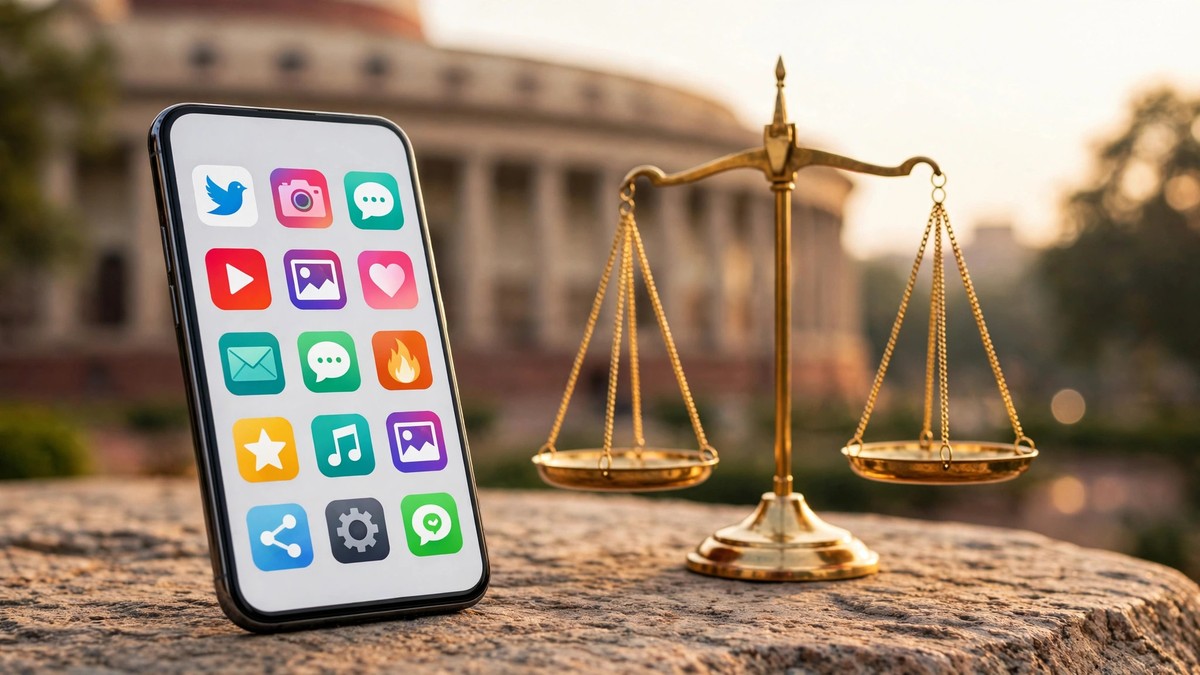
India is considering stripping Facebook, Instagram, YouTube and X of the legal shield that protects them from liability for what their users post — a change that would redraw the rules for some of the world’s biggest internet companies.
Key Points
- India’s IT Ministry has begun talks on a sweeping overhaul of social media rules, including ending the legal immunity platforms enjoy for user-posted content.
- The shield, known as “safe harbour” under Section 79 of the IT Act, 2000, protects intermediaries from liability for third-party content.
- The government is exploring limiting that protection to services that only carry information, such as internet providers and peer-to-peer messaging.
- Social media firms that use algorithms to rank, recommend and amplify posts could lose the protection, officials say.
- The talks are exploratory and no decision has been taken; any change would need an amendment to the IT Act approved by Parliament.
India’s IT Ministry has begun discussing whether to strip Facebook, Instagram, YouTube and X of the legal immunity shielding them from liability for user-posted content.
What happened
The Ministry of Electronics and Information Technology has opened discussions on a broad overhaul of India’s social media rules, The Indian Express reported on 5 November. At the centre of the talks is “safe harbour”, the legal protection under Section 79 of the Information Technology Act, 2000, that shields internet intermediaries from being held responsible for what their users upload, provided they meet prescribed due-diligence conditions.
According to two senior government officials, the government is exploring whether that protection should be kept only for services that simply transmit or carry information — internet service providers, telecom operators and peer-to-peer messaging platforms — rather than social media companies that actively decide what content users see.
The emerging view inside the government is that social media platforms can no longer be treated as passive carriers. Their algorithms rank, recommend and amplify posts, and they moderate content under their own community guidelines, which do not always align with Indian law. A section of the government believes that amounts to exercising editorial control — and raises the question of whether these companies should keep the same legal protections as traditional intermediaries.
“Intermediaries were supposed to be simply carriers of content, and safe harbour in that sense made sense,” a senior government official told The Indian Express. “But with social media platforms deploying complex algorithms to boost engagement and virality, the boundaries have been blurred. They definitely determine what gets shown to users, and are no longer simple carriers of content.”
The discussions are still at an exploratory stage, and no final decision has been taken on the shape of any change. Stripping social media companies of safe harbour would most likely require amending the IT Act, 2000, which would have to be approved by Parliament. Questions sent to the IT Ministry, Meta and Google drew no response before publication, according to the report.
Why it matters
Safe harbour is one of the most consequential legal protections behind the modern internet economy. It has allowed companies such as Meta, Google and X to build huge businesses around user-generated content without taking on the legal liability of publishing every post, video or comment themselves. Removing it for social media would fundamentally change how those companies operate in India — and set up a major confrontation between the government and the technology industry.
The debate is not happening in a vacuum. Friction between New Delhi and the platforms has intensified in recent months. In July, the IT Ministry summoned Meta’s global policy executives, including its global affairs president Joel Kaplan, after a video uploaded by Prime Minister Narendra Modi was briefly withheld by Facebook in India during student protests. The government had also raised concerns about deepfakes and Meta’s compliance with Indian law.
X, owned by Elon Musk, has challenged the government’s online content-blocking framework, including the use of its Sahyog portal to issue removal notices. In September 2025, the Karnataka High Court dismissed X’s challenge to the mechanism; the company has appealed. The dispute has become emblematic of the widening disagreements between the government and technology platforms over the boundaries of online speech and the state’s authority to regulate it.
India’s own AI push shows the other side of the same coin: New Delhi wants to shape the technology its citizens use, not just host it. The government launched three home-grown AI models under the IndiaAI Mission this week, and it is pressing ahead with rules for how global platforms operate inside the country — from Apple Intelligence arriving in China after a long regulatory wait to India’s own efforts to set the terms for AI and social media at home.
The government’s thinking has also been spurred by the courts. In an order on 15 October in the Just Rights for Children Alliance vs S Harish case, the Supreme Court raised concerns about social media companies’ failure to adequately prevent the circulation of child sexual exploitation and abuse material. The court observed that Section 79 was inadequate to address persistent regulatory failures, describing the loss of safe harbour as too drastic a consequence for routine non-compliance but insufficient to deter violations. It called for a separate framework of proportionate penalties, including monetary fines, while keeping the loss of safe harbour as a last resort for serious violations.
What happens next
Three things to watch. First, the talks themselves: officials say stakeholder consultations would take place before any proposal is finalised, and the technology industry and civil society groups are expected to oppose any substantial dilution of the protection. Second, Parliament: any withdrawal of safe harbour would need an amendment to the IT Act, which must be approved by lawmakers — a process that would take time and invite public debate. Third, the wider rulebook: the government is also considering whether platforms should have to inform authorities before introducing major product changes, after it directed WhatsApp in July to halt the rollout of a username feature over fraud concerns, and whether to overhaul grievance systems so users can seek faster removal of deepfakes and non-consensual images. For now, nothing has changed — but the direction of travel is clear.
Sources: The Indian Express, “IT Ministry weighs ending safe harbour for social media platforms”, 5 November 2026 (original source); Business Standard, “Govt weighs removing ‘blanket protection’ for social media platforms”, 4 November 2026; Free Press Journal, 5 November 2026 (independent coverage). The discussions are exploratory and no final decision has been taken. Published: 5 November 2026, Kuala Lumpur time.