
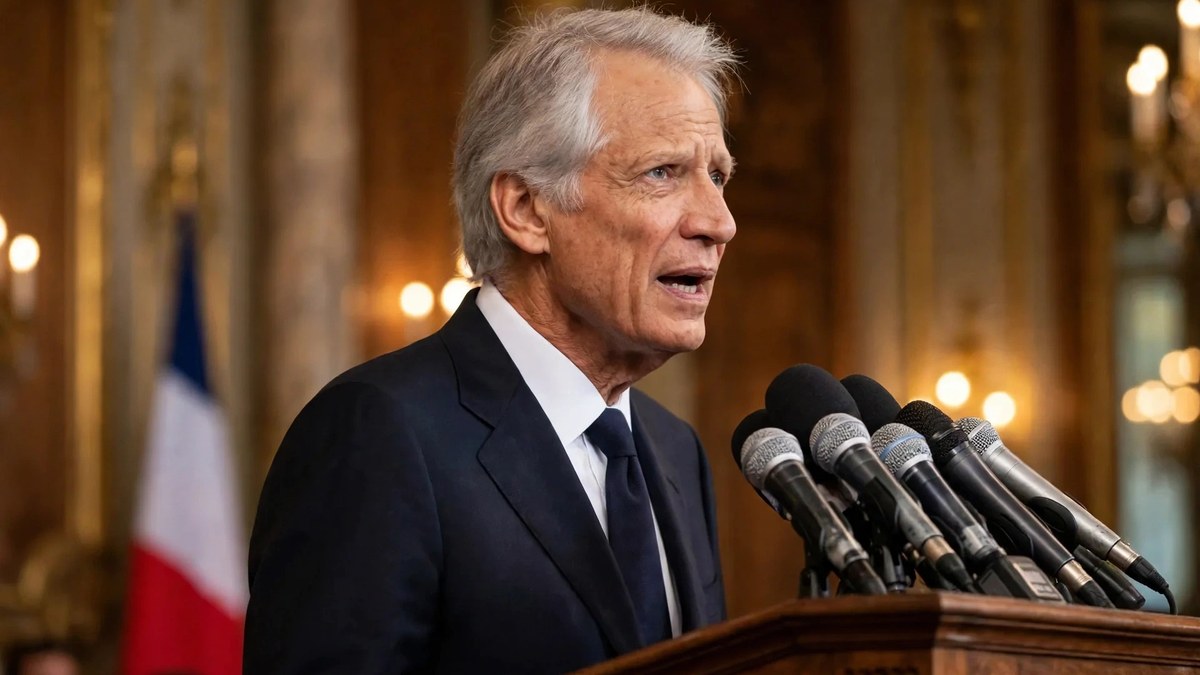
Dominique de Villepin, the former French prime minister best known for opposing the Iraq war at the United Nations, announced in Paris on Friday that he will run for president in 2027.
Villepin, 73, said he was standing to heal a divided France. He attacked Emmanuel Macron’s movement as a spent force, rejected both the far right and the far left, and claimed the legacy of Charles de Gaulle for his campaign. The announcement adds another name to an already crowded centre, five months before the first round of voting.
Key Points
- Dominique de Villepin, 73, announced on Friday 20 November that he will run for president of France in 2027.
- He founded the movement La France Humaniste in 2025 and presents himself as a Gaullist alternative to Macron, Marine Le Pen and Jean-Luc Mélenchon.
- He called a Le Pen victory a grave threat and described Macron as a “ghost president”.
- Recent polls put him at about 3 percent of first-round voting intentions. Le Pen leads the field.
- To stand, he must collect 500 sponsorships from elected officials. His team says about 300 pledges are already secured.
- France votes in the first round in April 2027, with the runoff on 2 May.
What happened
Villepin made the announcement at a press conference at the Maison de l’Amérique latine in Paris. He spoke for a long time about a country he described as in peril, and said his decision had been a heavy and difficult one, taken in full knowledge of the burden that will fall on the next president.
“There is something like a death instinct hanging over our country,” he told the room. “That is why I am a candidate for the presidential election in 2027.”
He framed his campaign as a fight for the Republic. He invoked de Gaulle repeatedly, and also named Georges Clemenceau and André Malraux. His team released its first campaign posters on Friday. They do not show his face. They carry the words: “What if we loved each other again?”
His targets were clear. He described Macron’s movement as a “dead star” and Macron himself as a “ghost president” who has failed to answer the country’s problems. He called Le Pen and Mélenchon “the two major forces of radicalism” who have increasingly taken over French political life. He said he did not see the two as equal threats, and that Le Pen’s National Rally carries a legacy of xenophobia, racism and antisemitism.
“Who can seriously believe that Marine Le Pen’s planned election next May would unfold peacefully?” he asked.
On policy, he promised to cut inequality and public debt, to defend international law, and to use referendums and talks with trade unions more often, including on pension reform. The economic detail behind those promises remains thin. He also called for a new “night of August 4”, a reference to the night in 1789 when feudal privileges were abolished, this time aimed at modern privileges, tax breaks and social exemptions.
“The French people need to be convinced that it is not a case of the richest 1 percent on one side and the remaining 99 percent, who are always the ones being asked to make sacrifices, on the other,” he said.
He said he wanted to move away from the “hyper-president” model he associates with Macron, and restore the president’s role as de Gaulle saw it: “an arbiter, a guide for the country”.
Why it matters
Villepin enters a centre that is already full. Former prime ministers Édouard Philippe and Gabriel Attal are also running for the votes of Macron’s camp, and Olympic judo champion Teddy Riner joined the race last week. With candidates from the traditional left and right fighting for the shrinking ground between the far right and the far left, there is a real fear that the centre splits its vote and clears the way for a runoff between Le Pen and Mélenchon.
Polls have pointed that way for months. Le Pen is the front-runner and could finish first in the opening round, something she has never done. She trailed Macron in the first round in 2017 and 2022, then lost to him in the runoff both times. Villepin, by contrast, is polling at about 3 percent.
The campaign will be fought on strained public finances. France’s public debt has climbed to a record 119 percent of gross domestic product, and it is likely to dominate the race. Villepin summed up the mood in a single line at his press conference: “The coffers are empty.”
The backdrop at home is restless. Protest marches have drawn huge crowds across France for weeks, with demonstrators demanding higher wages and backing a student protest movement. Villepin accused officials of ignoring what the protesters want, and of answering them with repression. France has also been in the headlines abroad this month: France blamed Iran for a cyberattack that heated supermarket fridges to 50°C.
Villepin is not a newcomer to the national stage. He served as foreign minister from 2002 to 2004 and as prime minister under Jacques Chirac from 2005 to 2007. Abroad, he is still best known for his 2003 speech at the United Nations, when he set out France’s opposition to the American-led invasion of Iraq. In recent years he has drawn attention beyond conservative circles for his support of the Palestinian cause and his criticism of Israel’s military campaign in Gaza.
What happens next
The first hurdle is practical. Every candidate must gather 500 sponsorship signatures from elected officials to appear on the ballot. Villepin’s team says it has secured about 300 pledges so far.
From there, the campaign runs to the first round in April, with the runoff on 2 May. The polls to watch are not only Villepin’s own numbers, but whether the centre candidates between them can keep Le Pen and Mélenchon from meeting in the final round. That question, more than any single candidacy, will shape the race from here.
Sources: Reuters, Associated Press, Le Temps, Agence France-Presse, The Straits Times. Published 21 November 2026.