An Anthropic mathematician says he and the company’s AI, Claude, have proved the Riemann hypothesis — maths’ most famous unsolved problem — and independent checks now say the proof looks real.
Key Points
- Levent Alpöge, a mathematician at Anthropic, posted a claim on Friday 20 November that he and Claude have proved the Riemann hypothesis, and its wider form, the generalised Riemann hypothesis.
- He released a four-page note and the proof written in Lean, a language that lets computers check each step of an argument. The full written version would run to more than 250,000 pages.
- Independent mathematicians have now compiled the Lean code without issues and say the proof is almost certainly true. A final comparator check — that the code proves the actual hypothesis, not a slightly different statement — is still pending.
- The problem, posed in 1859, carries a $1 million prize from the Clay Mathematics Institute. A solution must also be published in a peer-reviewed journal and survive two years of scrutiny.
What happened
On Friday, Alpöge put a short statement on his own website. “I believe I have, working with Claude, discovered a proof of the Riemann Hypothesis,” he wrote. The note runs to four pages, and with it he published the argument in Lean, software that checks a mathematical proof line by line. He said the result also settles the generalised version of the problem, a broader claim that reaches across much of number theory.
The work, he said, came together late on Sunday night into Monday. He spoke to Anthropic chief executive Dario Amodei before going public, and he accepted that the timing could look cynical — it came days after Anthropic’s record stock-market debut, the largest flotation on record. Shares in the company closed up 17 percent on their first day of trading. Anthropic itself has said nothing about the announcement so far.
He was frank about the limits of what he has released. The readable version of the argument is, in his words, “some massive unreadable travesty of ‘slop’” running past 250,000 pages, so only the Lean code has been published for now. He also said he has not yet mastered every part of the mathematics himself and plans to write the argument up properly.
Why the Riemann hypothesis matters
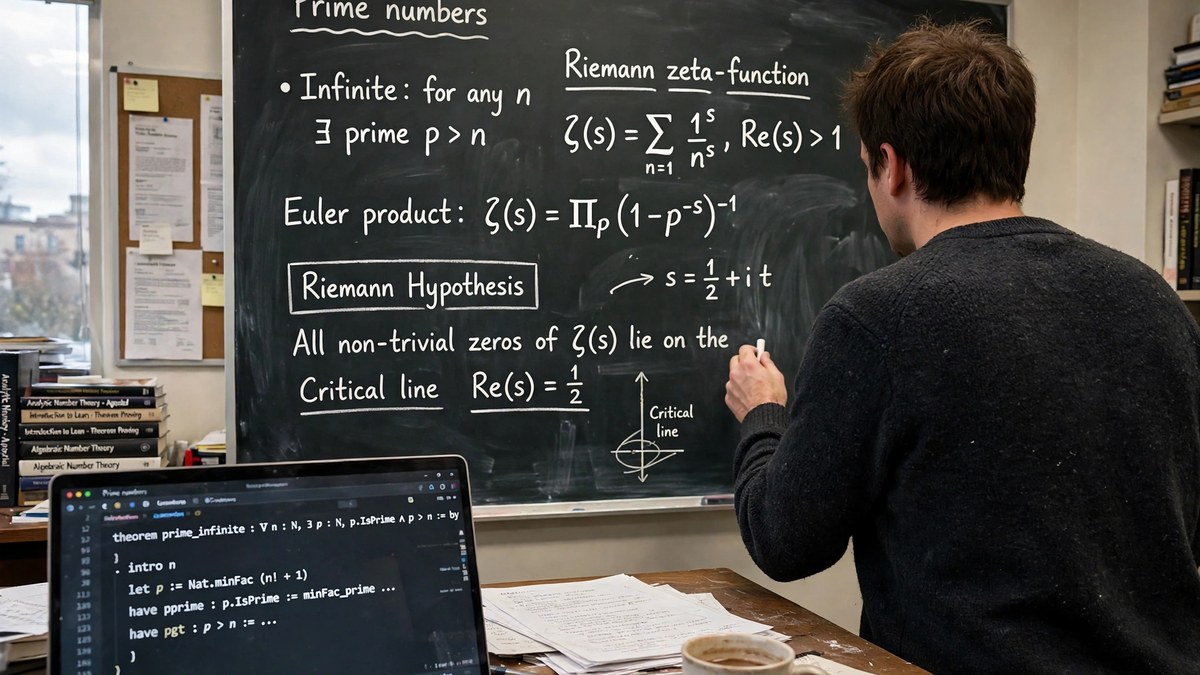
The hypothesis dates to 1859, when the German mathematician Bernhard Riemann proposed it. It is about the prime numbers — the numbers divisible only by themselves and one — and the hidden order behind where they fall along the number line. Riemann’s guess was that every non-trivial zero of a function called the zeta function sits on a single line, where the real part equals one half. No one has proved it in 167 years, and it is widely seen as the most important open question in pure mathematics.
It is one of seven Millennium Prize Problems named by the Clay Mathematics Institute in 2000, each carrying a $1 million prize. Under the institute’s rules, a solution must appear in a peer-reviewed journal and then stand up to two years of examination before the money is paid.
The first reactions have been cautious but striking. Andrew Sutherland, a mathematician at MIT, compiled the Lean code on his own and called it “an historic moment”. “The world has changed,” he said. Hector Pasten, a mathematician at the Pontifical Catholic University of Chile, said that if the proof holds, “this completes a dictionary between different branches of math where the connections were only partial”, calling it “something like a Rosetta Stone”. Carlo Pagano, a professor at Concordia University, said that even from a first scan it looked “very plausible” that the new ideas would open “brand new avenues of thinking in number theory”.
For ordinary life, a proof would change little at once. It would not break the encryption that guards online banking: knowing whether a number is prime is not the same as finding the factors of the huge numbers that encryption rests on. The larger signal is about artificial intelligence itself. A machine helping to settle a problem that the best human minds could not crack in more than a century and a half would show that AI can do more than explain old theorems — it can help build new knowledge.
What happens next
The Lean code has now been compiled independently by researchers including Andrew Sutherland at MIT, who said the chance anything is “fishy” is “approximately zero”. One check remains: a comparator run to confirm the code proves the actual hypothesis rather than a slightly different statement. That check could take hours, and a full reading of the reasoning will take far longer. Alpöge plans to write the argument up in full, and the Clay prize rules mean a peer-reviewed paper and two years of scrutiny lie ahead before anyone can call the problem solved.
The claim caps a year in which AI has pushed deep into mathematics. In August, Anthropic said an unreleased version of Claude had improved a long-standing result connected to the Riemann hypothesis, while stressing it had not proved it. In October, OpenAI released a large set of AI-generated mathematics that made progress on the primes. And two months ago, OpenAI said an AI model had solved another Millennium Prize Problem, the equations that govern how fluids move — a proof mathematicians say looks correct but has not yet been fully vetted. Alpöge was at the centre of a dispute over credit for that work.
Sources: Scientific American, AFP via Phys.org, The Wall Street Journal, Mathrubhumi. First published 21 Nov 2026. Updated 21 Nov 2026 with independent verification reports. The claim was posted on 20 Nov 2026.