Microsoft chief Satya Nadella has defended offering voluntary buyouts to about 60,000 employees, saying the move gave staff a choice as artificial intelligence reshapes every job at the company.
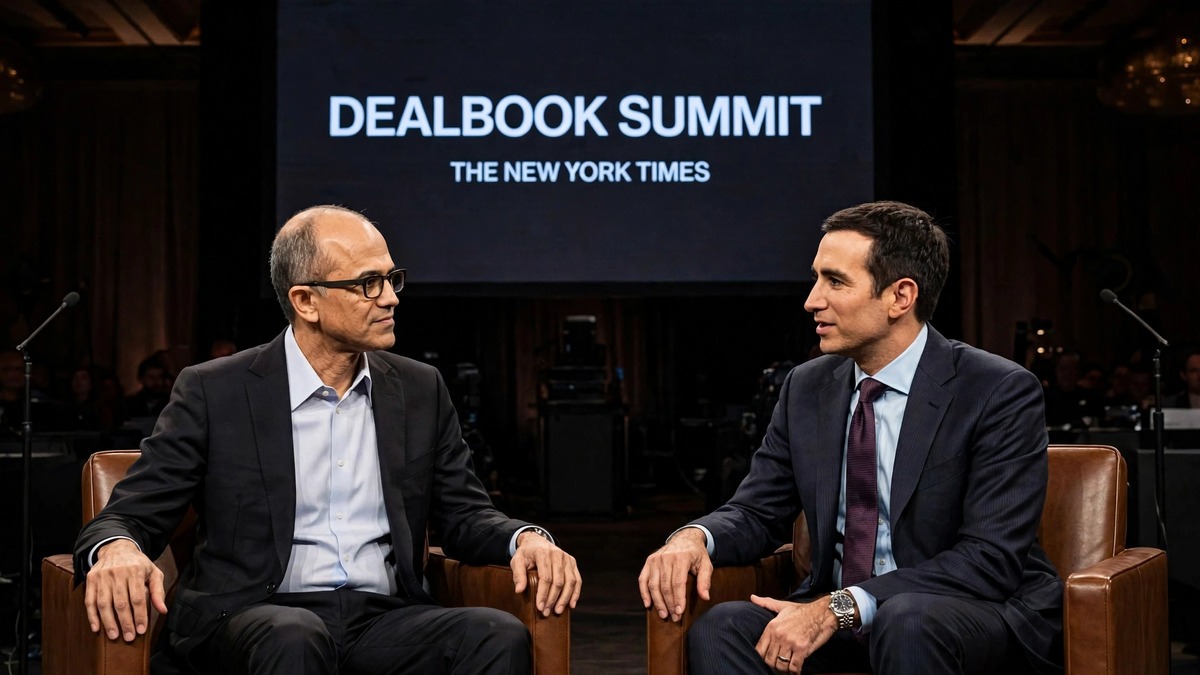
The defence came at the New York Times DealBook Summit on Wednesday, 18 November, three weeks after the offer went out — and it landed as workers were already pushing back, calling the AI-first push relentless. Nadella admitted his own messaging had left staff anxious about their futures, even as he insisted the buyouts were not about replacing people with machines.
Key Points
- Nadella told the DealBook Summit the buyouts were about giving staff agency: “to make sure that at least everyone felt like they had agency in making choices.”
- About 60,000 employees — roughly 27% of Microsoft’s 223,000 workforce — were offered the voluntary exit on 26 October.
- Eligible staff decide in early December and leave on 31 December; Microsoft expects fewer than 5% to accept.
- The package matches standard severance: base pay tied to tenure and level, continued stock vesting, healthcare and career help.
- Nadella says jobs will shift toward managing AI agents, pointing to an 11-person team building the Cowork agent in Microsoft 365.
- Workers have pushed back in an open letter calling the workplace “joyless and demoralizing” as AI spending climbs toward $170bn this year.
What happened
Nadella spoke to Andrew Ross Sorkin at the New York Times DealBook Summit on Wednesday, 18 November. He explained the October offer in plain terms: rather than another mass layoff, the company gave people a funded way out.
The offer, announced on 26 October in a memo from chief people officer Amy Coleman, covers staff at level 70 and below in participating teams in the United States, Canada, the United Kingdom and India. Sales teams and some engineering and data-centre groups sit outside it.
It is the company’s second buyout this year, after an April offer to about 8,600 long-serving US staff, and it follows about 4,800 job cuts in July.
Nadella’s argument is that AI is not simply replacing workers; it is changing how work is organised. He traced software engineering’s arc: from doubting AI could write code, to fearing it would replace engineers, to a new shape where engineers direct AI systems. His example was Cowork, the AI agent inside Microsoft 365 apps: a team of just 11 developers who, in his words, “build a software factory that builds the product. They don’t build the product.”
He also owned the anxiety his own messaging has caused. “We have created enormous anxiety in people sort of feeling that they don’t have control of their own destiny because the way we have talked about this AI revolution,” he said. He criticised talk of the singularity and predictions that AI will take every job. Of the change ahead, he said: “I cannot say it’ll all be the same.”
Microsoft is 51 years old, he noted, and “didn’t grow up as an AI-first company” — so the shift “is going to take a bit more time than anyone expects.”
Why the Microsoft buyouts matter
The number looks like a layoff of a quarter of the company. It is not. The 60,000 figure is eligibility, not departures. Microsoft has said it expects under 5% of those eligible to take the offer — fewer than 3,000 people, about 1.3% of the workforce. It has no target for how many will accept, and it has announced no layoffs alongside the programme.
The deeper story is the trade-off the numbers describe. Microsoft reported a 32% jump in quarterly profit to $36.6 billion on $92.3 billion of revenue, while capital spending rose 30% to $45.2 billion in the quarter, mostly on data centres. The company expects to spend about $170 billion this calendar year, largely on AI infrastructure.
The workers’ side of that trade-off is the open letter reported by The New York Times on 7 November. Current and former staff described the workplace as “joyless and demoralizing”, pointing to forced adoption of AI tools with little training, rising workloads, and merit rises below 1% for some. The gap between Nadella’s “agency” framing and that experience is the heart of the controversy.
The signal reaches beyond one company. If the software giant tells a quarter of its staff to choose between an AI-shaped job or a paid exit, other big employers will watch the uptake figure closely — and the record Anthropic IPO this week shows how much money is now chasing the same AI bet.
What happens next
Eligible staff must decide in early December — some reports put the deadline at 9 December — and those who accept leave on 31 December.
The first hard number, how many actually took the offer, will come in Microsoft’s disclosures. It will show whether the “agency” offer was a real release valve or a quiet headcount cut, and it arrives as scrutiny of AI spending grows, from questions over Nvidia’s chip sales to China to the outage that locked Microsoft 365 users out of their email days earlier.
Nadella’s reorganisation continues regardless: AI products and cloud infrastructure were folded into one group, Agents and Infra, in September. Investors will judge the AI-first bet on the next earnings — and on whether the 11-person Cowork model spreads across the company.
Sources: TechCrunch, CNBC, Reuters, Business Insider, Fortune, The New York Times | 20 November 2026, Kuala Lumpur time