US Defense Secretary Pete Hegseth signed a military cooperation deal with Venezuela on Wednesday, ten months after American forces removed Nicolas Maduro from power in Caracas.
Key Points
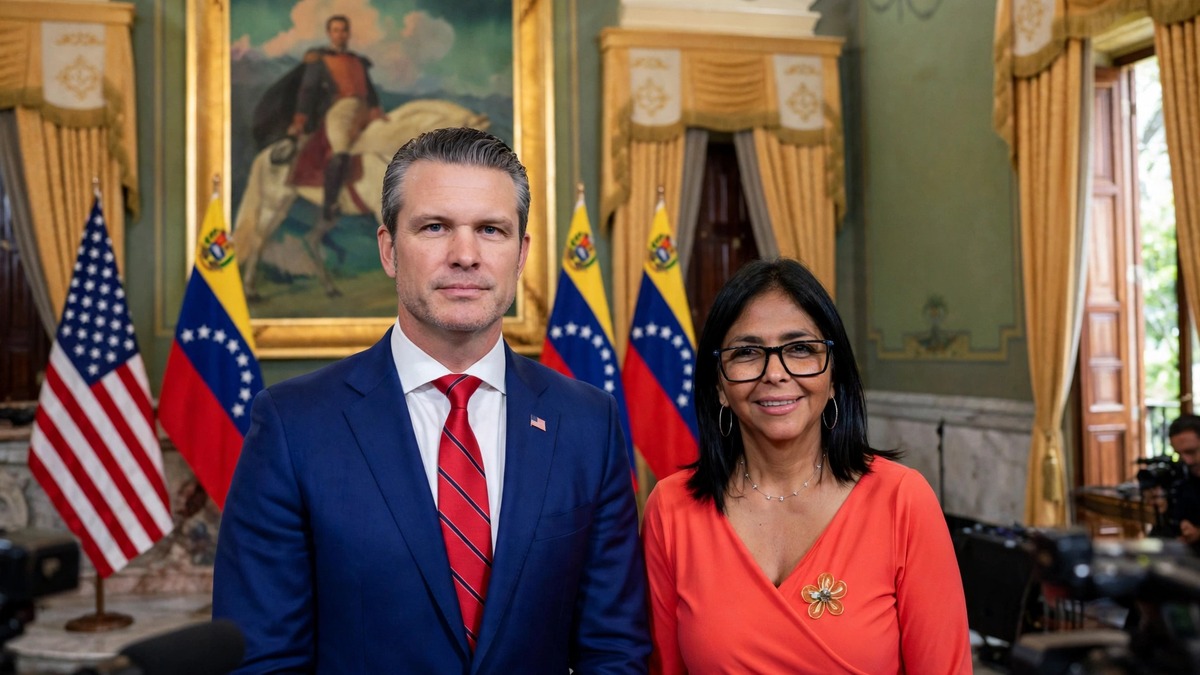
- Hegseth made an unannounced visit to Caracas on Wednesday and signed the deal with interim President Delcy Rodriguez at the Miraflores presidential palace.
- The agreement covers joint training, intelligence sharing, military equipment and border security, but its full terms have not been made public.
- Hegseth said Venezuela had gone from “our most aggressive regional threat” to a “compliant security partner” and boasted that the operation that seized Maduro lasted just 48 minutes.
- Washington now controls the flow of Venezuela’s oil revenue, giving the Trump administration leverage over Rodriguez’s government.
- The House voted 211-204 on November 10 against impeaching Hegseth for now, but Democrats could try again after they take the House in January.
What happened
Hegseth arrived in Caracas without advance notice on Wednesday and met Rodriguez at the Miraflores presidential palace, where the two appeared together in comments carried by state television channel VTV. Standing beside Rodriguez, Hegseth said the two countries had signed an agreement to strengthen their military forces and border security.
“We look forward to … deepening our defense cooperation and our defense partnership in ways that utilize the expertise of the US military and the war department alongside the great capabilities of your military,” Hegseth said, according to Reuters.
Rodriguez welcomed what she called a restart of military cooperation to face “common threats.” She said the renewed chance to strengthen training for the Bolivarian National Armed Force, improve its equipment and gain access to new technologies was highly beneficial for her military personnel. She added that she hoped cooperation “can be brought to its highest possible level.”
The deal covers joint training, intelligence sharing, more defence equipment and border security, and aims to help Venezuela recover territory from drug trafficking networks, Hegseth said. He offered few specifics beyond that. The Pentagon did not immediately give further details on the new partnership, and neither side has published the full terms of the agreement.
Hegseth used the visit to praise the January operation that seized Maduro, calling it “the single most sophisticated military operation in the history of Latin America.” He said it “lasted just 48 minutes” and added: “America’s best and bravest warfighters solved a 27-year problem for this hemisphere in a matter of hours.” He also turned one of Maduro’s own phrases back on him, saying the operation ended with “no war, yes, peace.”
He also praised the energy agreement struck in August, under which US interests gained access to Venezuelan oil fields. Hegseth said the Venezuela oil deal “makes the Strait of Hormuz a nonfactor for the Western Hemisphere.” Rodriguez said the deal enables “the energy development of our nations” and “benefits both the people of the United States and the people of Venezuela.”
Among those present for Hegseth’s speech was Alejandro Betancourt, owner of North American Blue Energy Partners, the second-largest oil operator in Venezuela. The company entered an agreement with the US government to tap Venezuela’s vast oil reserves. Both the Interior and Energy secretaries visited Venezuela earlier this year with a focus on its oil reserves and critical minerals.
Hegseth later travelled to Bogota, Colombia, where he was greeted at a military base by the country’s defence and foreign ministers. The visit there included the delivery of a C-130 military aircraft and talks on security cooperation.
Why the Hegseth Venezuela deal matters
The agreement marks a sharp turn in a relationship that was hostile for years. In January, US forces removed Maduro from power and took him to New York, and the Trump administration has since taken a leading role in Venezuela’s oil industry. Venezuela holds the world’s largest oil reserves, and the money from its oil sales now flows through accounts controlled by the United States.
According to a Department of State report released on November 12, more than $12bn from Venezuela’s oil and other natural resources passed through those accounts between January and September. The US government said nearly 99 percent of the money had been paid out, mostly to people and businesses in Venezuela through commercial banks. But Caracas still depends on Washington to approve the release of the funds, which gives the Trump administration a powerful tool to put pressure on Rodriguez’s government.
Political analyst Carlos Pina told Al Jazeera the timing of the visit matters, particularly after the Democrats won the midterm elections in the US on November 3. “I think many of the things happening between the United States and Venezuela are closely related to the November 3 election results,” Pina said. He said Democrats have already said they aim to increase scrutiny of US foreign policy towards Venezuela, including the agreements reached with Caracas during 2026, after US forces removed Maduro and took him to New York.
Pina said the visit was also partly aimed at defending Trump’s Venezuela policy before Democrats take control of Congress in January. “Hegseth goes to Venezuela, which is probably one of Trump’s few foreign policy successes, to show the American public that the plan they are carrying out in Venezuela benefits US national interests,” he said.
That scrutiny is already a live threat to Hegseth himself. On November 10, the House of Representatives voted 211-204 against impeaching him for now, but Democrats could try again after January, with their new majority in the House. The resolution, introduced by Republican Thomas Massie, included eight articles of impeachment related to the US-Israel war on Iran, military strikes on suspected drug-trafficking boats and the January operation that ousted Maduro. Massie said Hegseth ordered an act of war against Venezuela without congressional authorisation.
The deal also raises questions about what Washington wants from Venezuela’s armed forces. Phil Gunson, a senior analyst at the International Crisis Group, told Al Jazeera that Rodriguez’s government is under considerable pressure from Washington. “If they decline to cooperate, they have been told they will suffer the same fate as Maduro, or worse,” he said. Gunson said the US controls most of Venezuela’s foreign earnings through oil revenue and can cut off the funds whenever it wishes.
Gunson added that much would depend on Washington’s intentions, asking whether it would seek to reform security forces whose leaders it has accused of drug trafficking, human rights abuses and working with Colombian guerrillas. He said the military as an institution is not in a position to resist US influence, though some senior officers could try to sabotage the process if they feared prosecution or losing their positions.
The agreement could also affect neighbouring Colombia, which shares a long border with Venezuela. Several Colombian armed groups operate on both sides of the border, including the National Liberation Army (ELN), which has fought the Colombian government for decades. Pina said joint military operations could weaken these groups, and the two countries could carry out joint operations, including air raids against armed groups in the border area. But he said Venezuela’s armed forces were unlikely to give the US a much larger role. “The Venezuelan armed forces are not going to concede beyond that,” he said.
There was a dispute on Wednesday over Colombia itself. The New York Times reported that Colombian President Abelardo de la Espriella had rejected a US proposal to allow joint military operations on its territory. De La Espriella denied the report, saying Colombia wanted to strengthen military cooperation with Washington, although the presence of foreign troops would require congressional approval. Hegseth also rejected the report, calling it “totally false.”
Hegseth also promised more strikes against drug cartels in the region as part of the renewed partnership. American forces have been attacking what the Trump administration says are boats smuggling drugs in the Caribbean Sea and the eastern Pacific Ocean. At least 240 people have been killed since the administration began targeting those it calls “narco-terrorists” in September 2025, although US officials have released little evidence publicly to support claims the vessels were carrying drugs or that the strikes have reduced the availability of drugs in the country.
For Rodriguez, analysts say the agreement is also about survival. Gunson said the simple answer is that her government wants to remain in power as long as possible. Pina described her approach as “a calculation of survival,” saying her government is willing to yield in some areas to the US government as long as its hold on power is not affected. She gains time, he said, because greater congressional scrutiny of Trump’s Venezuela policies could eventually give Caracas more room to negotiate.
Rodriguez, a Maduro ally, took over after Maduro’s capture, even though her court-allowed term expired in July. She has continued to function as Venezuela’s head of state. Meanwhile, opposition leader Maria Corina Machado recently returned to Venezuela from exile. US Secretary of State Marco Rubio has said her “safe” return was the result of “reconciliation talks” supported by the US, which he called the best opportunity Venezuela has had in three decades to achieve free and fair elections and a lasting democracy. No date has been set for the next presidential election.
What happens next
The deal comes in the same week Trump met Xi Jinping and Vladimir Putin in Shenzhen, where the three leaders ended their first trilateral meeting with a four-point declaration and no breakthrough on Ukraine, Iran or nuclear arms. The full terms of the military agreement remain unpublished, and the Pentagon has not said when joint training or intelligence sharing will begin, or whether US forces will operate on Venezuelan soil. Those details will decide whether the deal is limited cooperation against armed groups on the Venezuela-Colombia border, as analysts expect, or the start of a larger US military presence.
Democrats take control of the House in January, and their promised scrutiny of the Venezuela agreements will test how much of the deal Hegseth is willing to defend in public. The impeachment question is also still open: the November vote blocked it for now, but the same charges can be brought again in the new Congress.
For Venezuela, the open question is the election. Rodriguez remains in charge with no date set for a vote, and Machado’s return has raised hopes among the opposition. Until an election is called, the military deal leaves Rodriguez dependent on Washington for both security cooperation and the release of her country’s oil money.
Sources: Reuters, Associated Press, Al Jazeera, The Manila Times, Daily Caller. Published 19 November 2026.