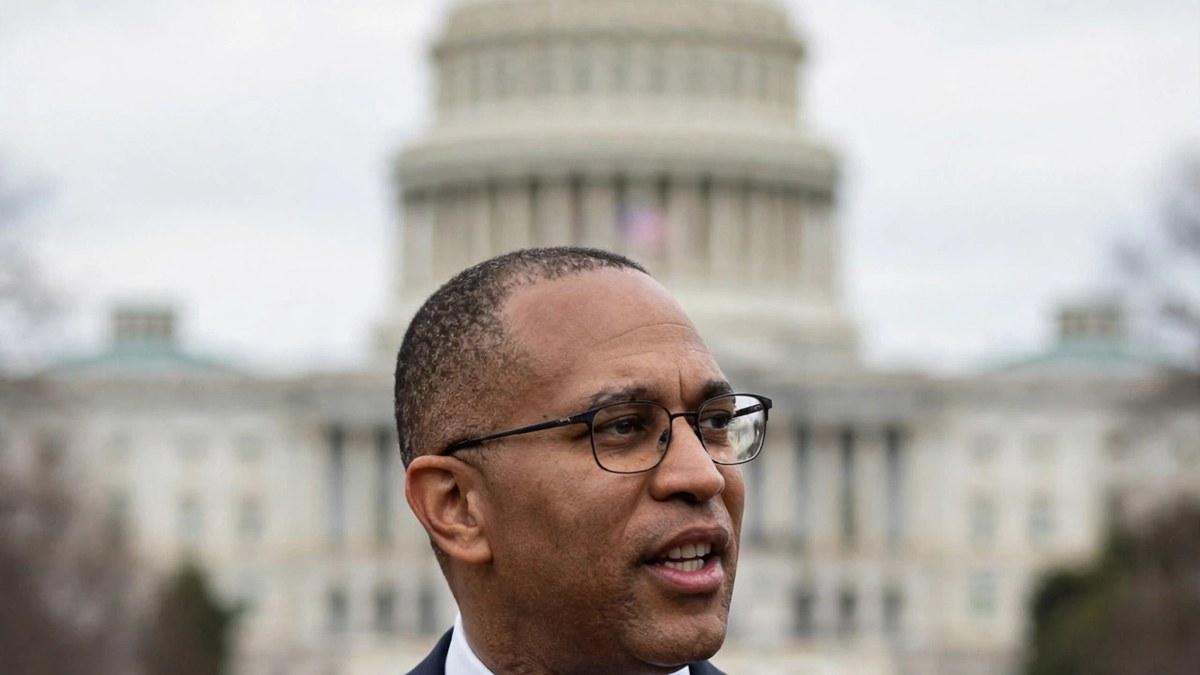
House Democrats nominated Hakeem Jeffries for Speaker on Wednesday, putting the 56-year-old Brooklyn congressman one floor vote away from becoming the first Black Speaker in American history.
Key Points
- House Democrats chose Jeffries as their Speaker nominee in a closed-door secret ballot on Wednesday, by 251 votes to 11. He ran unopposed.
- If the full House elects him on 3 January, he will be the first Black Speaker in US history, taking a role that follows the vice-president in the order of succession.
- Eleven Democrats voted against him, including seven incoming and sitting members who said publicly they wanted firmer commitments on their priorities.
- Democrats are projected to hold at least 257 of the House’s 435 seats, so Jeffries can afford to lose almost 40 of his own members and still reach the 218 votes he needs.
- He will face incoming Republican leader Jim Jordan in the floor vote. The current Speaker, Mike Johnson, stays in the job until 3 January.
What happened
The vote took place behind closed doors on Wednesday morning, roughly two weeks after Democrats swept the midterm elections and retook the House. Jeffries was the only candidate. He had asked for a recorded vote instead of being nominated by acclamation, so the count was made public while individual ballots stayed secret. In the end, 262 ballots were cast: 251 for Jeffries, 11 against.
The result had been widely expected. Jeffries led Democrats to their midterm sweep, and no challenger stepped forward. Even so, a small group on the party’s left had refused to promise their support in advance, pressing for commitments on issues including votes on Medicare for All and a halt to arms sales to Israel. Seven incoming and sitting Democrats later said publicly that they had voted no.
Before the vote, Representative Jim Clyburn, one of the most senior members of the Congressional Black Caucus and a longtime ally, spoke up for Jeffries in the room. “Hakeem is interested in headways and not headlines,” Clyburn said, in a speech one person present described as powerful.
Jeffries, 56, has represented a Brooklyn district in the House since 2013. He took over as the Democrats’ leader in January 2023, succeeding Nancy Pelosi, and became the first Black lawmaker to lead a major party in either chamber of Congress. Three years ago, after Kevin McCarthy was ousted as Speaker, Democrats put Jeffries forward for the job. He lost those floor votes, and the gavel went to Mike Johnson.
Why Jeffries’ nomination matters
The speakership is the most powerful job in the House, and no Black lawmaker has ever held it. If Jeffries wins the floor vote in January, he will break that barrier while leading the largest Democratic House majority in years.
The size of that majority is what makes the outcome all but certain. Democrats are projected to hold at least 257 of the chamber’s 435 seats, close to 260. Jeffries needs 218 votes on the floor, so he could lose nearly 40 members of his own party and still take the gavel. That cushion is why the 11 votes against him, while a public sign of friction with the party’s left, do not threaten his path.
The nomination also frames the agenda for the next two years. Jeffries has said Democrats will use their first 100 days to deliver on campaign promises about affordability and accountability, to roll back Republican policies and to investigate the Trump administration.
What happens next
The formal vote comes on 3 January, when the new Congress is sworn in. Electing a Speaker is the first act of the House, and the winner needs 218 votes. Jeffries is expected to face Jim Jordan, the Ohio congressman House Republicans chose as their leader last week.
The rest of the Democratic leadership team is falling into place alongside him. Katherine Clark of Massachusetts is running unopposed for majority leader, and Pete Aguilar of California for majority whip.
Until January, Mike Johnson remains Speaker. If Jeffries is elected as expected, he will take the gavel the same day the new Congress convenes, opening two years in which Democrats will run the House for the first time since losing it in 2022. Democrats cleared 250 House seats in the midterms, their biggest majority since 2008.
Sources: CNN, Reuters, Al Jazeera, Associated Press | 19 November 2026