The president denies taking any money and says stepping aside is the way to clear his name.
Key Points
- President Ukhnaa Khurelsukh said on Tuesday he will resign over graft claims linked to a coal railway project.
- The claims centre on $110 million allegedly paid around the 267 km Tavantolgoi–Gashuunsukhait railway, with $25 million said to have reached the president. The claims are unproven and denied.
- The opposition Democratic Party demanded on Monday that officials step aside and face investigation, and threatened impeachment.
- Khurelsukh denies wrongdoing and says he will cooperate with investigators and become an ordinary citizen.
- His resignation takes effect only if parliament accepts it. The speaker would then take over, and an election must follow within four months.
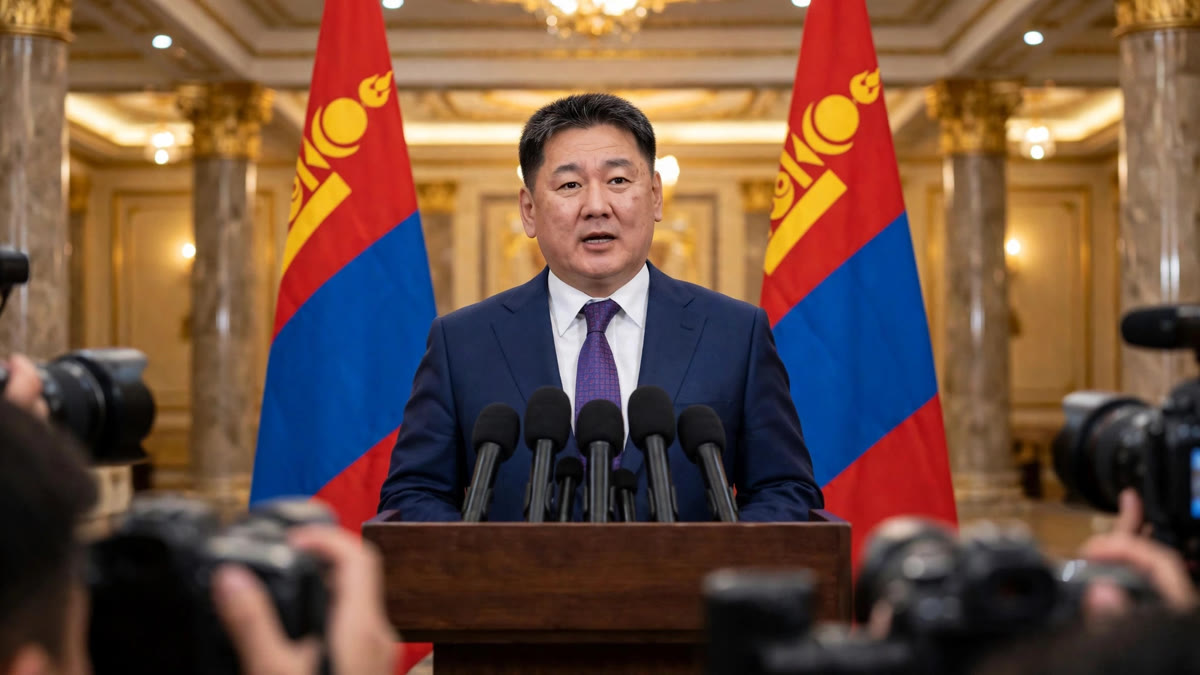
Mongolia’s President Ukhnaa Khurelsukh said on Tuesday he will resign over corruption claims tied to a coal railway, denying any wrongdoing and offering to face investigators to clear his name.
The announcement deepens months of political turmoil in Mongolia, a country that has already changed prime minister three times in nine months. If parliament accepts his resignation, it would be the country’s first time a president has stepped down voluntarily.
What happened
Khurelsukh spoke at a press conference in Ulaanbaatar on Tuesday. He said he had been falsely accused and defamed with what he called extremely serious crimes, and that resigning was the right way to establish the truth.
“It is consistent with the principles of justice for the President of Mongolia to step down and establish the truth,” he said. “I will be investigated and will have my honor restored.”
He told reporters he had never stolen from the people or the state, and had never lied or deceived anyone. “I will hand over my duties as president and become an ordinary citizen,” he said, adding that he would cooperate with investigators and refer those who defamed him to the authorities.
The claims surfaced on Saturday, when Nyambaatar Khishgee, a former mayor of Ulaanbaatar and a politician from the ruling Mongolian People’s Party, said in a livestream that Bodi International, the contractor behind the railway, had received $110 million in state funds during construction, and that $25 million of it had gone to the president. The allegation is that Khurelsukh made sure the railway contract went to Bodi International in 2019 without a competitive tender, and took bribes from the company in return.
Bodi International denied on Monday that it had paid cash bribes to senior government officials or civil servants, calling the claims defamatory and saying the company had done nothing wrong.
The opposition Democratic Party piled on the pressure the same day. It said the country had become deeply corrupt and called for senior officials named in the claims, including the president, to step aside and face investigation. All 42 of the party’s lawmakers signed a proposal for a temporary parliamentary committee to investigate, and the party threatened impeachment if he stayed.
Mongolia’s anti-corruption agency has looked into the $110 million figure. According to a report by Kursiv, its inquiry found no evidence that $110 million was paid out in cash, but it did identify 286 billion togrog, about $79 million, in advance payments.
Why it matters
The railway at the centre of the row is the 267 km Tavantolgoi–Gashuunsukhait line, a strategic link that carries Mongolia’s coal to China. The money claims around it have not been proven, and the president denies them. But the row has already cost a head of state his job, at least in intention.
Khurelsukh has been president since 2021, when his Mongolian People’s Party swept the legislature. His party has since been split by infighting, and the country has cycled through three prime ministers in nine months. Lawmakers appointed the third in March, after weeks of anti-corruption protests in which thousands of young people marched in Ulaanbaatar against wealthy elites and what they saw as pervasive injustice. A year earlier, Prime Minister Oyun-Erdene lost a confidence vote amid corruption-related protests.
The resignation also lands in a week when Asia’s leaders are in focus. Leaders gathered in Manila for the ASEAN summit, and President Donald Trump is travelling in the region for talks that include a meeting with China’s Xi Jinping.
What happens next
The announcement does not end Khurelsukh’s presidency on its own. Under Mongolia’s rules, his formal resignation must first go to parliament’s Standing Committee on State Structure, which has five working days to review it, followed by a parliamentary vote within another five working days. Approval needs a majority of all lawmakers.
If parliament accepts it, Speaker Sandag Byambatsogt will exercise presidential powers until a new president is inaugurated. A presidential election must be held within four months, bringing forward a vote that had previously been expected in June 2027.
The investigation the president invited will also have to run its course, along with the opposition’s push for a parliamentary committee and for the state coal miner Erdenes Tavan Tolgoi to publish its offtake agreements. Until parliament votes, the question is still open: whether Khurelsukh formally submits his resignation, and whether lawmakers accept it.
Sources: Associated Press, Agence France-Presse, Montsame, Capital Markets Mongolia, Kursiv. Published: 17 November 2026, Kuala Lumpur time.