

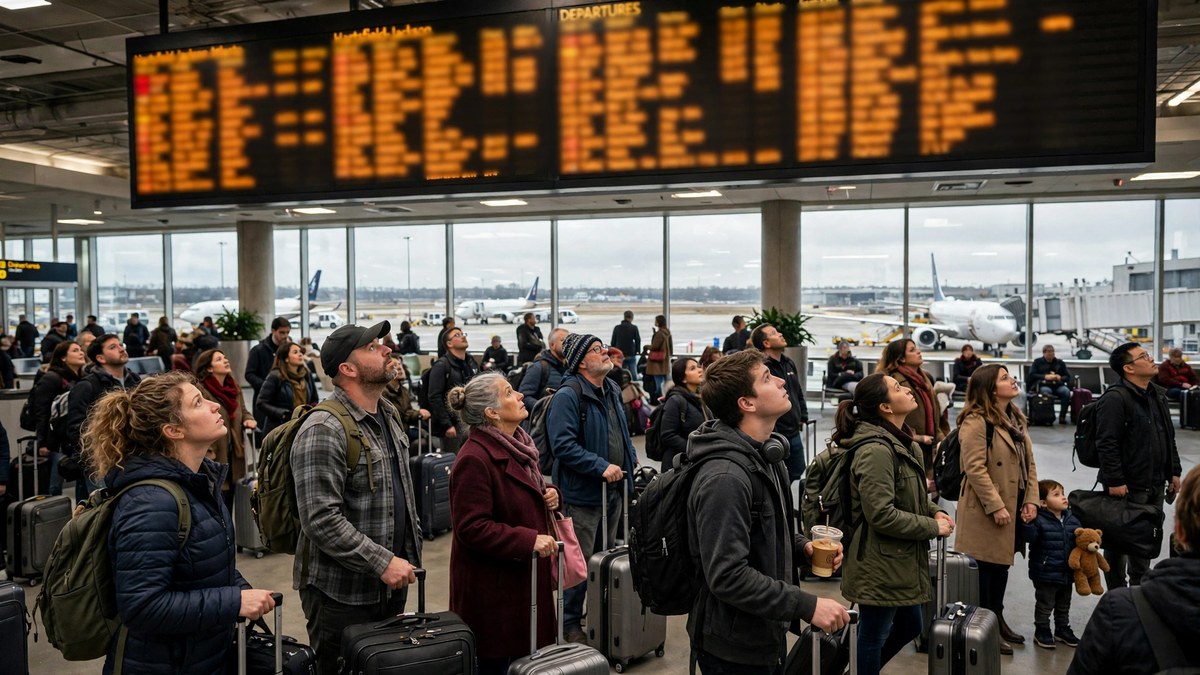
Delta Air Lines delayed about 2,000 flights on Sunday after the system that calculates each plane’s weight and balance failed, stranding Thanksgiving travellers at Atlanta, the world’s busiest airport.
Key Points
- Delta’s Automated Load Instruction System, which works out the weight and balance of each departing plane, stopped working on Sunday morning. Ground crews fell back on manual calculations while technicians raced to fix it.
- The Federal Aviation Administration briefly halted Delta flights heading for Atlanta, then replaced the stop with a ground delay. The delay was lifted at around 11:30 a.m. ET, according to an FAA advisory.
- By Sunday evening, FlightAware counted about 2,000 Delta flights delayed — 58 percent of the airline’s schedule — and more than 200 cancelled.
- Delta says about 70 percent of Sunday’s delays and cancellations came from the automation fault. The rest came from bad weather and air-traffic control programmes in New York and the Northeast.
- The airline said the system was working again by about 3:30 p.m. ET, but flights were still not back to normal hours later, and 34 flights for Monday had already been cancelled in advance.
- More than four million travellers are expected to pass through Atlanta’s airport between 19 November and 1 December.
What happened
The trouble started early on Sunday, at the start of the busiest travel week of the year. Delta’s system for planning the loading of each aircraft went down, leaving ramp crews without the worksheets they normally use to tell baggage handlers where each bag should go.
With no automated figures to work from, staff counted bags by hand and worked out the numbers on paper. In a radio call captured on Sunday morning, one Delta employee told a pilot in Boston: “Right now, it’s a system-wide outage for Delta Air Lines. The ramp isn’t really able to load because there is no ramp worksheet in there, so that’s what we’re doing, we’re manually counting bags and doing a report for you guys.”
The Federal Aviation Administration stepped in for about an hour, stopping Delta flights bound for Hartsfield-Jackson Atlanta International Airport, Delta’s home base and the busiest airport in the world. The stop was then eased into a ground delay, which held arriving Delta flights back and stretched delays to around an hour at the worst point. The delay was lifted at around 11:30 a.m. ET. The airport said the disruption affected Delta flights only and was not airport-wide.
Delta said later on Sunday afternoon that the automation was working again, and the airline stressed that the failure was not the result of a hack. The FAA confirmed separately that the problem had nothing to do with its own air-traffic systems.
Even so, the backlog kept growing long after the fix. By midday, close to half of all Delta flights were running late. By the evening, FlightAware put the figure at about 2,000 delayed flights, or 58 percent of Delta’s schedule, with more than 200 cancellations. At Atlanta itself, about 58 percent of departing flights and half of arriving flights were delayed. Delta had about 5,000 flights scheduled for the day.
Why it matters
The timing could hardly be worse. Thanksgiving week is the busiest travel period in the United States, and AAA expects 81.5 million Americans to travel at least 50 miles from home between Tuesday and next Monday. Atlanta is the hinge of the whole system: more than four million travellers are expected through its airport between 19 November and 1 December, and a snarl there ripples across the country.
It is also the second time in ten days that American air travel has been thrown off course by a technology failure. On 13 November, a telecommunications fault forced the FAA to halt flights across the country for more than four hours, disrupting more than 18,000 flights and affecting about a million passengers. Sunday’s breakdown was Delta’s own system, not the FAA’s, but for passengers stuck in the terminal the effect was much the same.
The system that failed is not a booking tool or a check-in app. Weight and balance is a safety calculation: before any plane takes off, crews must confirm that its total weight and centre of gravity sit within strict limits, or the aircraft may not handle as the pilots expect. The FAA’s own pilot handbook calls compliance with those limits critical to flight safety. That is why, when the automation went down, Delta slowed everything to a crawl rather than dispatching planes without the numbers.
Other airlines have been here before. United Airlines suffered a failure in its own weight-and-balance computer system in 2025 that caused more than 1,000 delays and dozens of cancellations, and it had a brief system outage on 16 November that affected fewer than 150 flights. Sunday’s Delta failure was far larger than either.
What happens next for Delta travellers
Delta said it hoped to have all of its delayed flights in the air by the end of Sunday, and it is rebooking passengers onto the next best itinerary, offering meals and hotel rooms where needed, and giving refunds to anyone whose flight was cancelled and who no longer wants to travel.
Some disruption will carry into Monday. The airline had already cancelled about 34 flights scheduled for Monday in advance, and passengers should expect lingering delays as aircraft and crews work their way back into position after a day spent out of sequence.
For travellers, the advice is straightforward: check flight status before leaving for the airport, allow extra time, and keep an eye on rebooking options in the Delta app. The airline has apologised for the delays. With the Thanksgiving rush still building toward its Tuesday and Wednesday peak, and storms also threatening the Northeast on Thursday, the next few days will test how quickly the system recovers.
For the full picture on the Thanksgiving travel rush, see our report on the storms threatening holiday travel. For another airport disruption this weekend, see the ICE arrests that delayed a flight at Seattle airport.
Sources: CNN, Associated Press, Reuters, USA Today, FlightAware | 23 November 2026