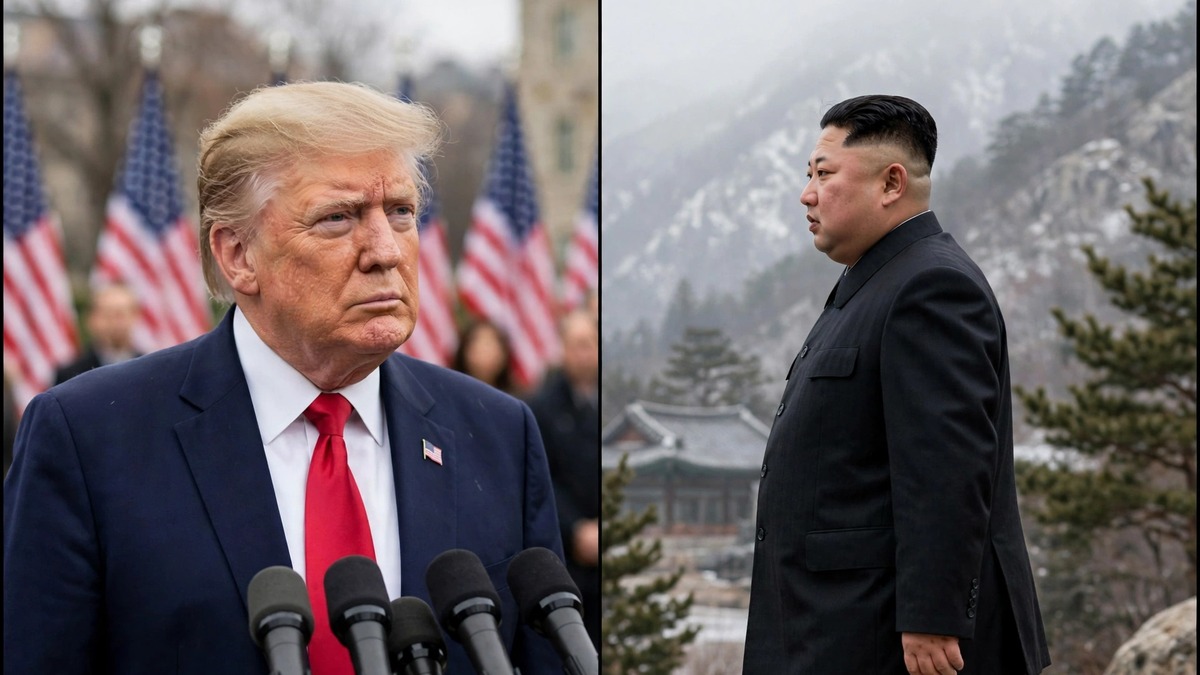
Kim Jong Un snubs Trump in Asia: the North Korean leader toured a ski resort and a sacred mountain while the US president flew home without the meeting he spent all week chasing.
Key Points
- Donald Trump left Asia late on Thursday, 19 November, without meeting Kim Jong Un, despite floating the idea repeatedly all week.
- Pyongyang stayed silent on the overtures. State media instead showed Kim at a ski resort, Mount Paektu, a naval university, and school-equipment factories.
- Trump said aboard his flight home that the two leaders will meet “at some point”, blaming a packed schedule.
- Korea experts doubt the schedule excuse, noting no sign of real back-channel talks and Kim’s distrust of Washington since the failed Hanoi summit in 2019.
- The door is still open: Pyongyang never said no outright, and analysts say a future meeting cannot be ruled out.
Donald Trump flew home from Asia without the meeting he wanted most. The US president left the region late on Thursday, 19 November, after a landmark trilateral summit with Chinese President Xi Jinping and Russian President Vladimir Putin in Shenzhen, but with no encounter with North Korean leader Kim Jong Un.
Trump had spent the week talking up the idea. He raised the prospect of a meeting as he travelled to Asia for a run of summits, and repeated it in China, saying the North Korean leader “would like to” meet him. He brought it up again at a meeting of Quad leaders in Manila on Tuesday. Each time, Pyongyang said nothing.
Instead of answering, North Korea’s state media filled the week with pictures of Kim doing anything but meeting Trump. On Sunday and Monday he toured a ski resort under construction in Samjiyon, near the Chinese border, with his daughter Ju-ae and his wife. Then came a visit to Mount Paektu, the sacred mountain at the heart of the Kim family’s founding story. On Wednesday he inspected a naval university, where he stressed the importance of maritime defence. On Friday he visited factories making school equipment and teaching aids, examining samples of desks and classroom fixtures, according to the Korean Central News Agency, which reported the visit on Saturday.
The message, in pictures, was hard to miss: Kim had other plans.
What happened
Trump’s Asia tour was built around the Shenzhen trilateral, the first time the leaders of the United States, China and Russia had sat down together in that format. The meeting produced a joint statement on nuclear risk, and Trump called the gathering a historic step. But the Kim meeting he had teased never materialised, and no meeting was publicly announced at any point in the trip.
Aboard Air Force One on the way back to Washington, Trump spoke to NBC News reporter Gabe Gutierrez and gave his version of events. “The relationship is there, but we didn’t meet,” he said. “There was too many meetings. It wouldn’t have worked out.” He added: “We’ll have that meeting at some point.”
It was not the first time Trump had chased the meeting. Since returning to the White House, he has repeatedly floated a new encounter with Kim, the leader he met three times during his first term. He reached out to Pyongyang ahead of an Asia tour last year, even describing North Korea as “sort of a nuclear power”, and got no reply. In March, South Korea’s then prime minister Kim Min-seok said Trump thought a meeting with Kim would be “good”. None of it produced a date.
The two leaders’ history explains part of the cold shoulder. Their summits in Singapore in 2018, Hanoi in 2019 and at the Korean border later in 2019 aimed to curb Pyongyang’s nuclear programme, but produced no lasting deal. The Hanoi talks collapsed outright, and Kim left empty-handed, making a roughly 60-hour train journey home. Read the full account of the Shenzhen meeting that closed Trump’s trip.
Why Kim Jong Un snubbed Trump
Korea watchers are not convinced by the crowded-diary explanation. “I am sceptical that any concrete behind-the-scenes contacts took place” between Pyongyang and Washington, Lim Eul-chul, a professor at Kyungnam University’s Institute for Far Eastern Studies, told AFP. After Hanoi collapsed, Kim likely “concluded that while he and Trump might understand each other personally, the US itself is fundamentally untrustworthy, regardless of whether a Republican or Democratic administration is in power”, Lim added.
Others made the same point in blunter terms. A proper summit would need far more groundwork than a passing remark on a tour. “A proper summit would require at least an exchange of special envoys and working-level negotiations,” Koh Yu-hwan, a professor emeritus at Dongguk University, told AFP. “Kim probably had no reason to be used for a photo opportunity aimed at boosting Trump’s political achievements without such preparations.”
The experts also read Kim’s public schedule as a deliberate answer. Tending to provincial matters in full view of the cameras, they said, sent a clearer message than silence from Pyongyang would have. It showed Kim setting his own timetable, not Trump’s.
There is a harder obstacle underneath the scheduling. Experts say Pyongyang is highly unlikely to respond to Trump’s overtures unless Washington takes concrete steps towards recognising it as a nuclear-armed state. The US government has so far stuck to its position demanding that Pyongyang give up its nuclear weapons, and Washington, Seoul and Tokyo reaffirmed their commitment to North Korea’s “complete denuclearisation” just weeks before Trump’s arrival in Asia. “Trump may have personally shown goodwill towards Kim, but I don’t think Kim feels that the United States, at its government level, has created a credible environment for resuming dialogue,” Lim told AFP.
Kim also has less reason to need Washington than he did in 2019. Pyongyang’s ties with Beijing and Moscow have deepened, and it is receiving economic and military support from Russia in return for its involvement in the Ukraine war, while expanding economic cooperation with China. Despite international sanctions, it keeps generating funds through activities including hacking and cryptocurrency theft. North Korea’s nuclear programme has kept growing in the meantime.
What happens next
Nothing is formally closed off. Pyongyang never rejected the idea outright, and that leaves the door open. “It seems like Trump is still eager to meet with Kim, and Pyongyang seems to be undecided, so the possibility cannot be ruled out,” Yang Moo-jin, former president of the University of North Korean Studies, told AFP.
For now, though, the scoreboard is plain. Trump spent a week publicly inviting Kim to meet, and Kim spent the week visiting a ski resort, a mountain and a naval university. The president who built his image on deal-making flew home with the deal he talked about most still unmade, and with the other side showing no sign of hurrying.
If a meeting ever happens, it will need what this week never had: envoys, working-level talks, and an agreement on what the two sides are even meeting about. Until then, Kim holds the stronger hand. He can wait. Trump, who told reporters the meeting will happen “at some point”, is the one doing the asking.
Sources: CNA/AFP, Yonhap News Agency, Daily Sabah, South China Morning Post, The Straits Times, NBC News (via CNA/Yonhap). Published Saturday, 21 November 2026.