Donald Trump has posthumously pardoned Pete Rose, baseball’s all-time hits leader, for a 1990 tax conviction. Announced on Truth Social on Thursday, the pardon does not change Rose’s path to the Hall of Fame.
Rose died in September 2024, so the pardon clears a conviction on a man who served his sentence more than 30 years ago. It also leaves untouched the one question his supporters care about: whether baseball’s hits leader will ever reach Cooperstown. That answer still belongs to a 16-member Hall of Fame committee, and it will not come before December 2027.
Key Points
- Donald Trump announced a posthumous pardon for Pete Rose on Thursday, 19 November, in a post on Truth Social.
- The pardon covers Rose’s 1990 conviction for filing false tax returns. It does not touch the gambling that got him banned from baseball.
- Rose died on 30 September 2024, aged 83. He finished his career with 4,256 hits, still the most in Major League Baseball history.
- The Hall of Fame is a private museum with its own rules. A presidential pardon cannot force it to elect anyone.
- Rose’s next chance comes in December 2027, when the Classic Baseball Era Committee votes. He would need 12 of its 16 votes.
What happened
Trump made the announcement while flying home from Asia, posting from Air Force One after he had met Xi Jinping and Vladimir Putin in Shenzhen. “I have just given a Complete and Total Pardon to the Late, Great Pete Rose, a true Baseball SUPERSTAR & LEGEND,” he wrote, praising a hits record he said would never be broken.
The post also named former pitcher Roger Clemens, who won 354 games in his career. Trump wrote that Rose had been “treated terribly by Major League Baseball in not allowing him to go into the Baseball Hall of Fame”, adding: “Politics, I guess!”
Trump had promised the pardon before. He first said he would pardon Rose on 28 February 2025, and in early 2025 he said he would sign it within weeks. He raised the idea again at a campaign rally in Texas in October, standing beside Clemens.
The pardon covers the only federal case on Rose’s record. On 20 April 1990, he pleaded guilty to two counts of filing false tax returns, admitting he had failed to report $354,968 of income over four years. Judge S. Arthur Spiegel sentenced him on 19 July 1990 to five months in prison, a $50,000 fine, 1,000 hours of community service and a year of probation. Rose served his time at a minimum-security camp in Marion, Illinois, from August 1990 to January 1991, and repaid the Internal Revenue Service $366,042.
One detail in Trump’s post was wrong. It described the 4,256 hits as a single-season record. The figure is Rose’s career total, built across 24 seasons from 1963 to 1986.
The ban and the long road back
Rose’s playing career ended in disgrace long before the tax case. In August 1989, he accepted a lifetime ban from the game. An inquiry run by lawyer John Dowd had found that he placed bets on the Reds during 1985 to 1987, seasons in which he both played for and managed his home-town club. Rose later admitted he had gambled on baseball, while insisting he never bet against his own team. He had denied the betting for 15 years.
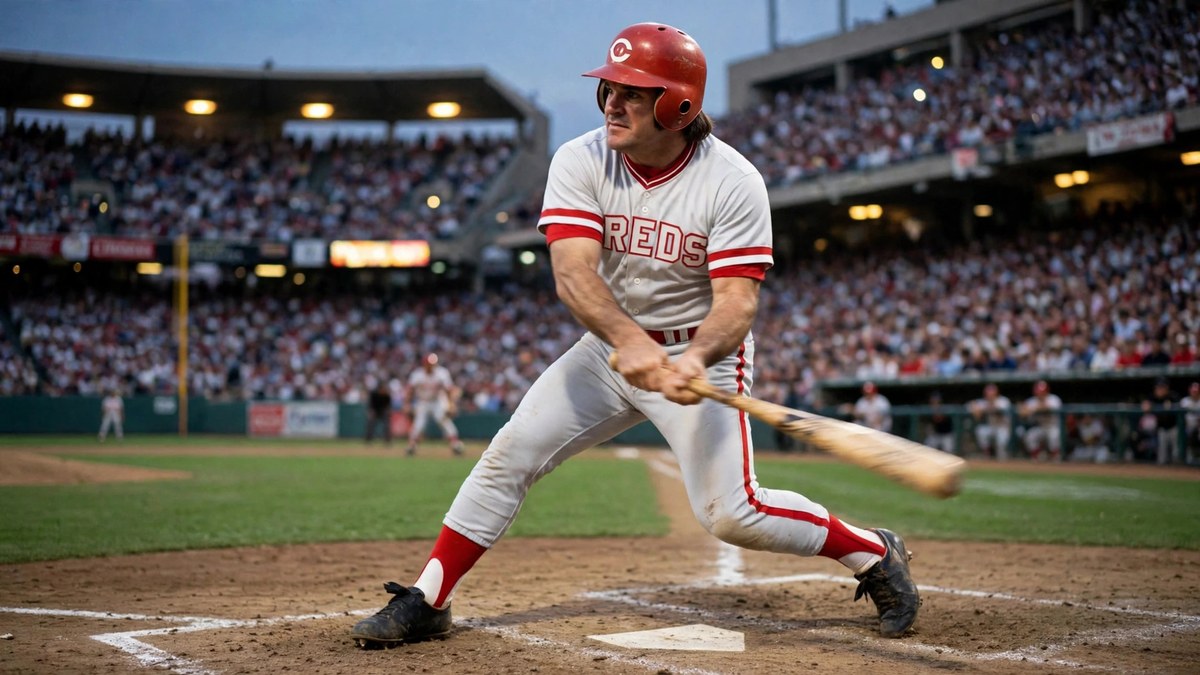
The numbers he left behind still stand. Rose played 3,562 games, also a record, won three World Series titles, took the National League’s Most Valuable Player award in 1973 and won three batting titles. Fans knew him as “Charlie Hustle” for the way he ran out every ground ball.
For 36 years, the ban kept him out of Cooperstown. The Hall’s board had ruled in 1991 that no one on baseball’s permanently ineligible list could be considered for election.
That changed in May 2025. Commissioner Rob Manfred ruled that permanent ineligibility ends when the person dies, restoring Rose and 16 others, including Shoeless Joe Jackson, to good standing. Manfred later admitted that Trump’s urging, delivered in a meeting at the White House in April, had influenced the decision.
Trump had pressed the case in public for months, and the pardon followed. But it runs on a different track from the Hall of Fame.
Why the Pete Rose pardon changes nothing
A presidential pardon forgives a federal crime. It cannot undo a prison term already served, and it cannot order a private museum to put a player on its wall. The Hall of Fame sets its own rules, and its next vote on Rose is fixed by its own calendar, not by the White House.
That is why the BBC called the pardon largely symbolic. The Justice Department does not usually process requests for pardons after death, although presidents have granted them before. The Hall did not answer a request for comment from Reuters, and a spokesman for Major League Baseball declined to comment. The BBC said it had also asked the Justice Department and the Hall for comment and received no reply.
Trump has no power over punishments handed down by a league. Baseball did not itself bar Rose from the Hall; the Hall, a separate body, made its own rule in 1991. The pardon leaves that rule exactly where it was.
What happens next
Rose’s case now rests with the Hall’s Classic Baseball Era Committee, which looks at players whose best years came before 1980. The group, made up of 16 Hall of Famers, club executives, historians and veteran writers, next meets in December 2027. A historical committee will first draw up a ballot of eight names. Rose must make that list, then win 12 of the 16 votes, or three quarters of the committee. If he is elected, he would be inducted in July 2028.
The committee meets once every three years. At its last meeting, in December 2024, it elected Dick Allen and Dave Parker.
His chances look far from certain. The committee has tended to follow the lead of the baseball writers, who refused to elect Barry Bonds and Roger Clemens, both tied to performance-enhancing drugs. Rose would need the committee to set the gambling question aside and judge him on what he did on the field.
Jeffrey Lenkov, a lawyer who has represented the Rose family in its push for reinstatement, told Reuters his case to the voters would rest on Rose’s record as a player.
Also on World Pulse Wire: Manchester United’s loss widened to £18.1 million as Mauricio Pochettino began work as manager, and GTA 6 scored 99 on Metacritic as its global launch began.
Sources: Reuters, Associated Press, CNN, USA Today and BBC reporting. Time: 20 November 2026, Asia/Kuala Lumpur.