Key Points
- Google DeepMind introduced Gemini Robotics 2.5 on 10 November 2026, calling it the most capable robot-control model it has built so far.
- On live Mercedes-Benz production lines in Hungary and Germany, Apptronik’s Apollo 2 humanoid sorted car parts with a 96% success rate, DeepMind says.
- Across more than 200 test tasks, the model succeeded 30% to 100% more often than earlier versions and finished 20% to 30% faster, according to DeepMind’s own tests.
- DeepMind also released ASIMOV-Jailbreak, an open test of 1,500 prompts that tries to trick robot brains into unsafe actions.
- The model is going only to DeepMind’s robotics partners for now. There is no public release, price, or general availability date.
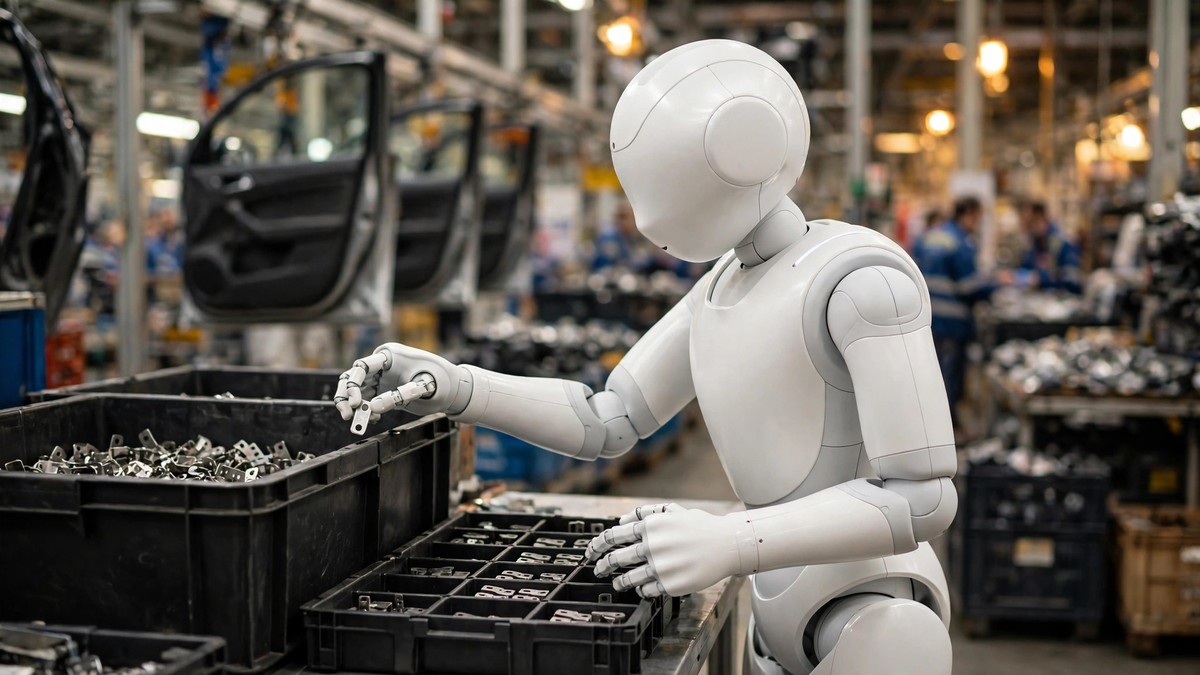
Google DeepMind’s Gemini Robotics 2.5 put Apptronik’s Apollo 2 humanoid to work on live Mercedes-Benz production lines in Hungary and Germany on 10 November 2026, sorting car parts with a 96% success rate.
Gemini Robotics 2.5 is the company’s latest vision-language-action model, and DeepMind calls it the most capable robot-control system it has built. The factory test is the point: a robot that can cope with a working production line, rather than a staged laboratory demo, is a step toward machines that do useful work beside people.
What happened
Gemini Robotics 2.5 turns what a robot sees and what it is told into physical movement. It watches a scene through cameras, works out the steps a job needs, and then drives the robot’s arms and hands. DeepMind describes it as the most capable version of this system it has released, and the latest to be put to work outside a laboratory.
The factory test ran at Mercedes-Benz plants in Kecskemét, Hungary, and Sindelfingen, Germany. There, Apollo 2 took on kitting, the repetitive job of lifting individual metal brackets out of bulk bins and placing them into trays in the exact order each vehicle on the line requires. Two models worked as a pair: Gemini Robotics ER, the reasoning model, kept track of the workflow, while Gemini Robotics 2.5 controlled the hands and arms, reaching into bins, picking up brackets, and placing them into sequencing containers while correcting for gaps.
DeepMind reports a 96% success rate for that pilot. The company calls it a proof of concept, not a finished deployment, and it has not published how many trials the figure covers, how long the test ran, or how often people stepped in. Those details matter, because a factory line needs near-perfect reliability, and 96% still leaves a gap a human worker would rarely leave.
The same model was tested on more than 200 different tasks in total, from serving food with tongs and tying a bow on a gift box to pipetting liquid. DeepMind says success rates rose 30% to 100% depending on the type of task, compared with its own earlier baselines, and tasks were completed 20% to 30% faster. All of those numbers come from DeepMind’s own evaluations, not from outside testing.
Gemini Robotics 2.5 is built to run on more than one kind of machine. It works with Apollo 2, which has a five-fingered hand with 22 degrees of freedom, and with the Franka Duo platform, which uses two-fingered grippers. DeepMind says the model is now rolling out to a small group of robotics partners, including Apptronik, Agile Robots, Boston Dynamics, and Enchanted Tools, as well as Mercedes-Benz as the factory pilot partner. There is no public API, no price, and no date for wider availability.
Why it matters
Robot demos usually happen in controlled rooms, where lighting, objects, and timing are all arranged in advance. A live production line is the opposite: parts arrive in jumbled bins, vehicles change, and the work never pauses. Putting a humanoid on that line, even for one task, is a far harder test than a staged video, and it is the test that decides whether factory robots move from research projects to real jobs.
The job DeepMind chose is also deliberate. Kitting is monotonous, physically tiring, and easy to get wrong when done by hand for hours. If a robot can take that work over reliably, technicians can spend their time on complex build tasks instead. That is the pitch DeepMind makes in its announcement, and it is the same argument every industrial robot maker has made for decades — the difference now is that the robot is being asked to cope with variation, not just repeat one fixed motion. Gemini is spreading beyond robots, too: the latest Pixel Drop brought Gemini Intelligence to the Pixel 10 range.
The safety work matters just as much as the factory result. As robots move into places where people work and live, a misunderstood instruction can become a physical accident. DeepMind says the new model uses reasoning at run time to steer around hazards, and its own tests show safe task completion improving by 33% near obstacles and by 43% near people. Those are the company’s own figures, and they have not been checked by an outside lab. Carolina Parada, who leads robotics at DeepMind, put the factory stakes plainly: “A very important thing is that 96 percent is not 100 percent, and in a real factory, every failure costs money.”
DeepMind has also published ASIMOV-Jailbreak, an open-source benchmark on Hugging Face that tries to fool robot models into unsafe actions with 1,500 disguised prompts across dozens of scenes. Its own model, Gemini 4 Argon, resisted 99.5% of those attempts, against 82% for the earlier Gemini Robotics ER 2, according to DeepMind. Ars Technica, reporting the same release, gives a different pair of numbers for the same test — 98.8% with Argon in the loop, against 73.5% for ER 2 alone. The two sets of figures come from different evaluations, and the gap is a reminder that safety scores depend on how the test is run. Argon also works as a safety layer on top of the robot’s planning, checking its plans before it acts. Making the test public lets other builders measure their own systems against the same trick prompts, which is a more useful contribution than any single score.
Behind the launch sits Gemini 4 Argon itself. DeepMind says Argon acted as a simulation engine during development, generating thousands of varied practice runs from a real camera scene and building a digital twin of the workspace. Combined with real training demonstrations, that helped the robot generalise to new scenes and objects faster. Argon could also study video of failures, suggest why they happened, and test fixes in simulation and on the real robot. Google is building the hardware underneath this push as well: its newest tensor processing units, designed for AI work, were unveiled earlier this month.
What happens next
The open question is the last 4%. DeepMind research scientist Kanishka Rao said it directly: “We’re always hoping to get to a hundred percent, and 96 percent is really good, but there’s a remaining four percent which we need to improve.” The real world, he said, throws up mislabelled boxes, carts of unexpected sizes, and trays shifted 20 centimetres to the left — ordinary surprises a laboratory never predicts.
Watch for three things. First, whether Mercedes-Benz extends the pilot beyond kitting to other line tasks, or keeps it as a single demonstration. Second, whether DeepMind opens the model beyond its partner group, and when developers outside that circle get access. Third, whether outside researchers adopt ASIMOV-Jailbreak and publish their own scores, which would give the safety claims a check DeepMind’s own tests cannot provide. The launch also lands in a busy week for AI companies: Anthropic has set a $70–$78 price range for its stock market debut.
For now, Gemini Robotics 2.5 is a capability announcement with a factory receipt attached. The robot worked on a real line, on a real task, and mostly got it right. The distance between mostly right and ready for the line is the story to follow.
Source: Google DeepMind blog, 10 November 2026; Ars Technica, 10 November 2026; The Decoder, 10 November 2026; Unite.ai; MLQ.ai. Time: 11 November 2026, 15:33 +08.