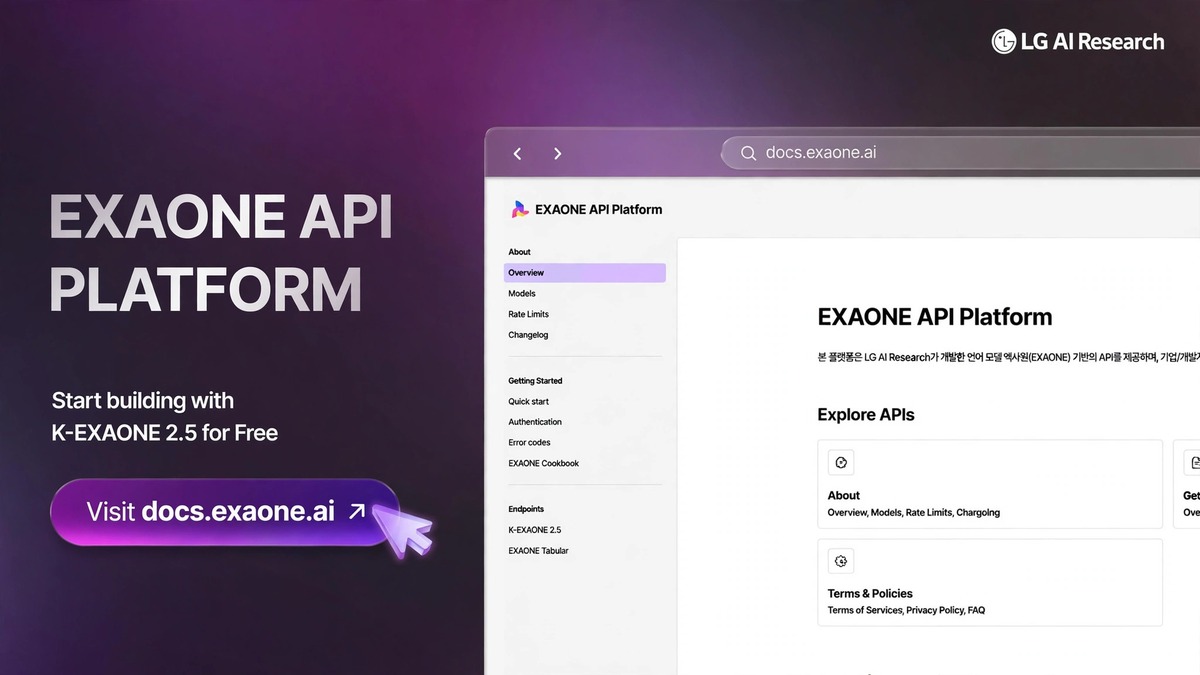
LG AI Research has opened its K-EXAONE 2.5 artificial intelligence model to developers free of charge, announcing the move at NVIDIA AI Day Seoul on Monday, 9 November.
Key Points
- LG AI Research opened the K-EXAONE 2.5 API free of charge on Monday, 9 November, at NVIDIA AI Day Seoul 2026.
- Developers, startups, companies and research institutes can get an API key through docs.exaone.ai and use the model at no cost.
- LG says the model improved by more than 70 percent across 24 benchmarks in eight weeks, based on its own tests.
- On LG’s own benchmark tests, the model scored 59.2 on SWE-Bench Pro, 78.0 on BrowseComp, 74.6 on AutomationBench and 77.3 on Claw-Eval, close to DeepSeek V4.1 Flash and GLM-5.3.
- The model has 750 billion total parameters, with 31 billion active, and a 512,000-token context window.
- LG aims to complete a frontier-level EXAONE model by January next year. It has not said how long free access will last.
What happened: K-EXAONE 2.5 goes free
The announcement came at NVIDIA AI Day Seoul 2026, held at COEX in southern Seoul on Monday. From the same day, developers, startups, companies and research institutes can obtain an API key from LG’s platform, docs.exaone.ai, and use the model to build services or run research without paying. LG has not published a free-tier quota, a rate limit, or a date when the free access might end.
K-EXAONE 2.5 is a technology-validation model. LG built it by adding further training to K-EXAONE 2.0, the open-weight model it released in August under South Korea’s sovereign AI foundation model programme, the government-backed effort to build homegrown AI and cut the country’s reliance on foreign systems.
The model works with text only, in Korean and English, and runs through an OpenAI-compatible endpoint. It has 750 billion total parameters, with 31 billion active at any one time, and can take in up to 512,000 tokens of context. Its knowledge runs to January 2026. LG also launched EXAONE Tabular, a 21-million-parameter model for predicting values from tables of data, alongside the API.
Why it matters
The headline numbers are LG’s own. The company says its internal tests across 24 benchmarks show overall performance up by more than 70 percent in eight weeks against its previous model. On four agentic tests, where AI plans work and uses tools by itself to finish real tasks, K-EXAONE 2.5 scored 59.2 on SWE-Bench Pro, 78.0 on BrowseComp, 74.6 on AutomationBench and 77.3 on Claw-Eval. Those results sit close to DeepSeek V4.1 Flash and GLM-5.3, the leading Chinese open-weight models, without beating them outright. No outside lab has independently reproduced the figures.
The free opening is also a test. LG calls 2.5 a validation model: opening it up lets outside developers probe its strengths and faults before LG builds its third-round model from what it learns. “We will focus on completing an EXAONE model with frontier-level performance by January next year,” said Lim Woo-hyung, co-head of LG AI Research.
The Nvidia link matters too. LG said it is considering NVIDIA’s Dynamo technology to make its models run more efficiently, and is pursuing technical cooperation with the chipmaker. Nvidia separately released Dynamo deployment recipes for four South Korean open models on 8 November, including K-EXAONE 2.0, and says the software can double inference performance on its B200 chips. No signed partnership between LG and Nvidia has been confirmed.
South Korea’s sovereign AI programme has several companies building national models at once. Kakao unveiled its Kanana 2 model and a separate AI decision model earlier this month, while LG is betting that free access will bring outside developers into its own ecosystem first. The wider AI race is also driving huge infrastructure spending: Anthropic has reportedly agreed a $3.4 billion deal for gas generators to power its data centres, the largest such purchase by an AI lab.
What happens next
Developers can start building on the free API now, with no payment and no published quota. Three things are worth watching: whether LG sets a usage limit or an end date for free access, whether it releases the 2.5 model weights — it has not said it will — and whether the frontier-level model promised for January arrives on schedule.
The Dynamo question is open too. If LG adopts Nvidia’s inference software, its models could run faster and cheaper on Nvidia hardware; if the cooperation stays informal, the free API alone will have to carry the ecosystem. Either way, the next test of K-EXAONE 2.5 will come from the developers using it, not from LG’s own benchmark sheets.
Sources: The Korea Times, NoCut News, Maeil Business Newspaper, Sports Chosun, AICoder, AI Affairs. Published: Monday, 9 November 2026.