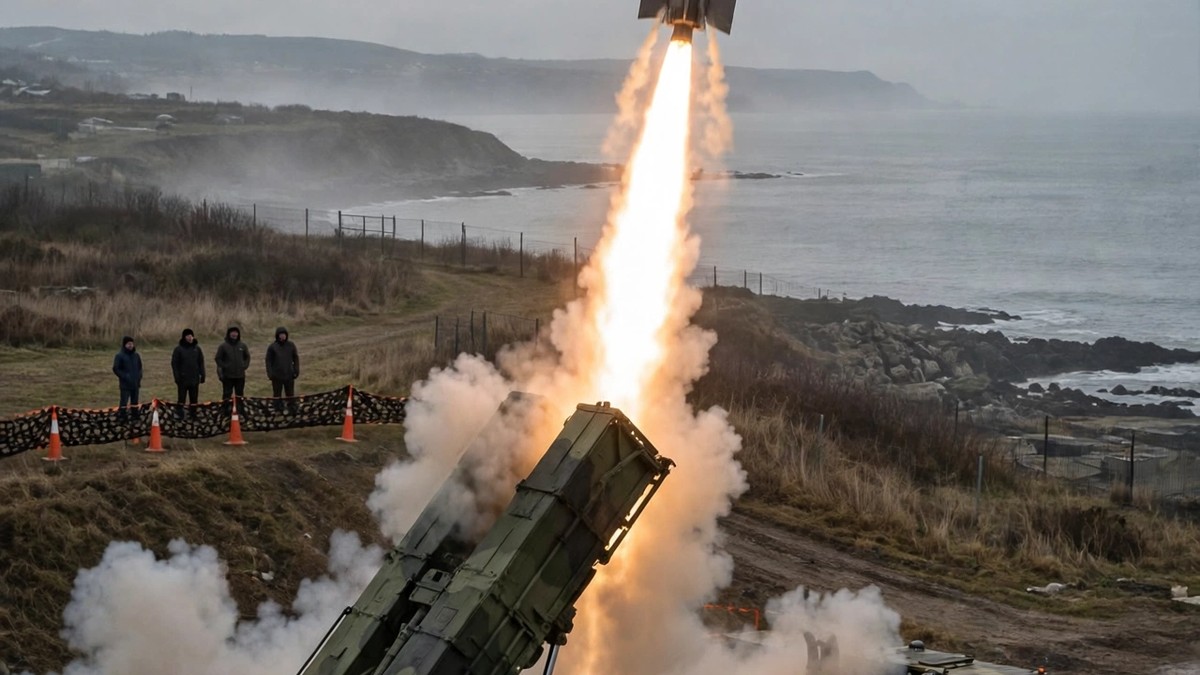
North Korea tested a new air-defence missile system on 4 November, state media reported on 5 November, in a fresh show of weapons capability that South Korea tracked from the country’s east coast.
Key Points
- North Korea says it test-fired a newly designed air-defence missile system on 4 November, with the news reported on 5 November.
- State media says the test confirmed the system’s guidance, tracking and detection abilities.
- A separate cruise-missile unit staged a strike drill against a virtual airport target the same day.
- South Korea’s military detected multiple missiles launched from Sondok toward the East Sea, flying under 300 kilometres.
- It was Pyongyang’s fourth weapons test in a week, according to the Korea Herald.
What happened
North Korea’s Missile Administration carried out the test on Wednesday, according to the Korean Central News Agency (KCNA), the country’s state news outlet. The test was overseen by Kim Jong-sik, a member of the Central Military Commission. KCNA said the firing proved the technical specifications and reliability of the system, including a new material, an intelligent multiple guided mode, and the ability to identify and track targets. It also said the system’s detection information processing device performed as designed.
On the same day, a firepower subunit of a long-range strategic cruise missile unit in the eastern area staged its own strike drill. KCNA said the unit struck a virtual airport target with a long-range strategic cruise missile and performed its mission perfectly. State media said both exercises were aimed at keeping weapons systems at a technically high level and improving the combat reliability of the strategic weapon.
South Korea’s Joint Chiefs of Staff said it detected the North firing multiple missiles toward the East Sea from the Sondok area in South Hamgyong Province early on Wednesday. The missiles are believed to have flown less than 300 kilometres. South Korean authorities left open the possibility that the launches involved a close-range ballistic missile, and said they were still analysing the details.
Why it matters
The test did not happen in isolation. It was the North’s fourth weapons test in a week, and it followed a run of recent demonstrations that included cluster munitions, attack drones, a precision-guided torpedo system and an intermediate-range hypersonic missile, according to AFP reporting. Taken together, the sequence points to a sustained programme of testing rather than a single event.
The choice of systems also matters. Air-defence missiles are designed to shoot down incoming aircraft and missiles, so a new system speaks to how Pyongyang wants to protect its own airspace and military sites. Cruise missiles, meanwhile, fly low and can be hard to track, and unlike ballistic missile launches, cruise missile tests are not prohibited by United Nations Security Council sanctions. That distinction shapes how neighbours and the wider world respond to each kind of test.
The timing added to the attention. The launches came as the United States voted in midterm elections, and North Korea has a history of launching missiles around American elections, a pattern widely seen as a show of force. This week, Kim Yo-jong, the powerful sister of leader Kim Jong-un, also issued back-to-back statements rejecting a United States investigation that blamed the North for stealing more than $6 billion in cryptocurrency from Binance. Pyongyang has also hardened its stance toward Seoul and Washington, with a landmine dispute straining inter-Korean relations.
What happens next
The immediate question is how South Korea, the United States and Japan respond in public, and whether any further tests follow in the coming days. South Korea’s military said it was continuing to analyse the launches, and further detail on the missiles’ exact type and range may emerge from that work. Analysts will also watch whether Pyongyang releases its own photographs or footage of the test, as it often does after weapons demonstrations, and whether the pace of testing slows or continues.
For now, the confirmed facts are narrow but clear: a new air-defence system was tested, a cruise-missile drill hit a virtual target, and multiple missiles were tracked flying under 300 kilometres from Sondok. Anything beyond that, including the system’s true performance, remains unconfirmed by independent evidence, because KCNA did not disclose the missiles’ ranges, flight paths, launch locations or targets in detail.
Related reading: Spain Names Interim Transport Minister After Crash and World leaders meet to push for calmer trade and steadier growth.
Sources: Yonhap News Agency (KCNA report) and AFP via Malay Mail, 5 November 2026. Facts verified against the original report and one independent source. Image is AI-recreated, not the original photograph.