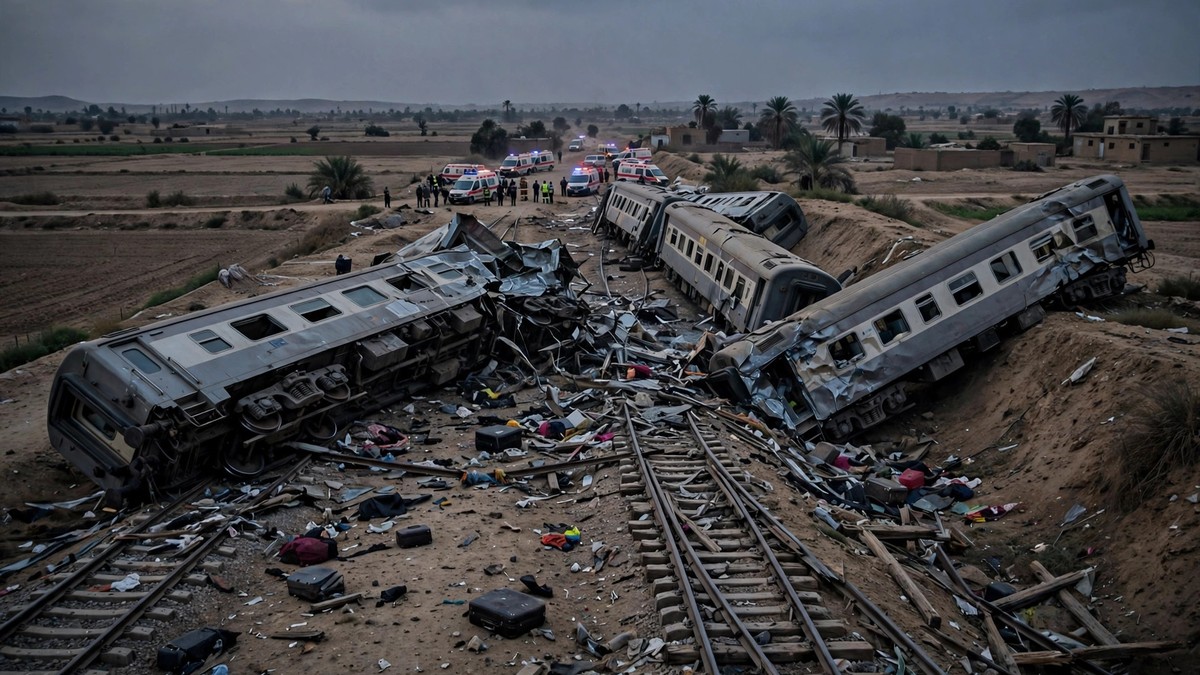
Seven people were killed and more than 100 injured on Sunday when a train travelling from Giza to Fayoum struck the rear of another train south of Cairo, Egyptian officials said.
Key Points
- Seven people were killed, including a train conductor, and 112 were injured in a rear-end collision in Al-Ayyat district, Giza province.
- Train No. 134, running from Giza to Fayoum, hit the rear of Train No. 2010, travelling from Cairo to Aswan, between Kafr Ammar and El Reqqa stations.
- President Abdel Fattah el-Sissi ordered an urgent investigation and said anyone found negligent would be held accountable.
- No cause has been given. Al-Ayyat was also the scene of Egypt’s worst rail disaster, in 2002, when a fire killed more than 360 people.
What happened
The crash took place on Sunday in the Al-Ayyat district of Giza province, about 52 kilometres south of Cairo, near the village of Gerza. The railway authority said the two trains were travelling in the same direction when the Fayoum service hit the back of the Aswan service, and the impact pushed several carriages off the track.
Investigators from the chief prosecutor’s office reached the site on Sunday evening. Their first inspection found that the Fayoum-bound train had struck the last carriage of the Aswan-bound train, which was standing still on the same track. A conductor was among those killed. The railway authority sent emergency teams and cranes to clear the wreckage and work to bring services back to their normal timetable.
The casualty figures rose through the day. The Health Ministry first reported four dead and 88 injured, then raised the toll to seven dead and 112 injured. The chief prosecutor’s office put the number of injured higher, at 125. Health Minister Khaled Abdel Ghaffar said 72 ambulances took part in moving the injured to hospitals around Giza, and the injuries included bruising, broken limbs, and fractures to the pelvis and spine, along with cuts to the head and face. The Health Ministry said more than 70 of the injured had been discharged after treatment.
No cause for the collision has been stated by any authority. The railway authority gave no reason for how two trains came to share the same track, and the public prosecution has opened an investigation into the technical circumstances of the crash. No finding of negligence has been announced.
Why it matters
Al-Ayyat carries a grim record on Egypt’s railways. In February 2002, fire swept through an overcrowded train carrying holiday travellers south of Cairo in the same district, killing more than 360 people in the country’s deadliest rail disaster. More crashes in the area in 2009 killed dozens more.
Rear-end collisions have also recurred elsewhere on the network. In March 2021, a passenger train ran into the back of another near Sohag, killing 18 people and injuring 200. Prosecutors later ordered the arrest of eight railway employees over that crash.
Egypt’s railways carry millions of passengers, and each fatal crash renews questions about signalling, maintenance and oversight on the network. Sunday’s collision, in a district already marked by the worst disaster in the country’s rail history, will put those questions back before the authorities and the public.
The crash also came on a weekend of deadly transport accidents elsewhere. In North Carolina, a driver ploughed into a group of cyclists, killing one person, while a migrant boat sank off Senegal with 21 people dead.
What happens next
The public prosecution’s team is examining the site, the wreckage and the records, and will set the exact toll and the sequence of events. President el-Sissi said he was following the accident with great concern and had directed the authorities to run an urgent investigation.
Railway crews are clearing the line so services can return to normal. The victims have not yet been named. The investigation’s findings, and any action against those responsible, will decide whether Sunday’s crash becomes another entry in Egypt’s long list of rail disasters or the point at which the system changes.
Sources: Associated Press, Reuters, Agence France-Presse, Dawn, Daily News Egypt, The Week. Published: Monday, 9 November 2026.