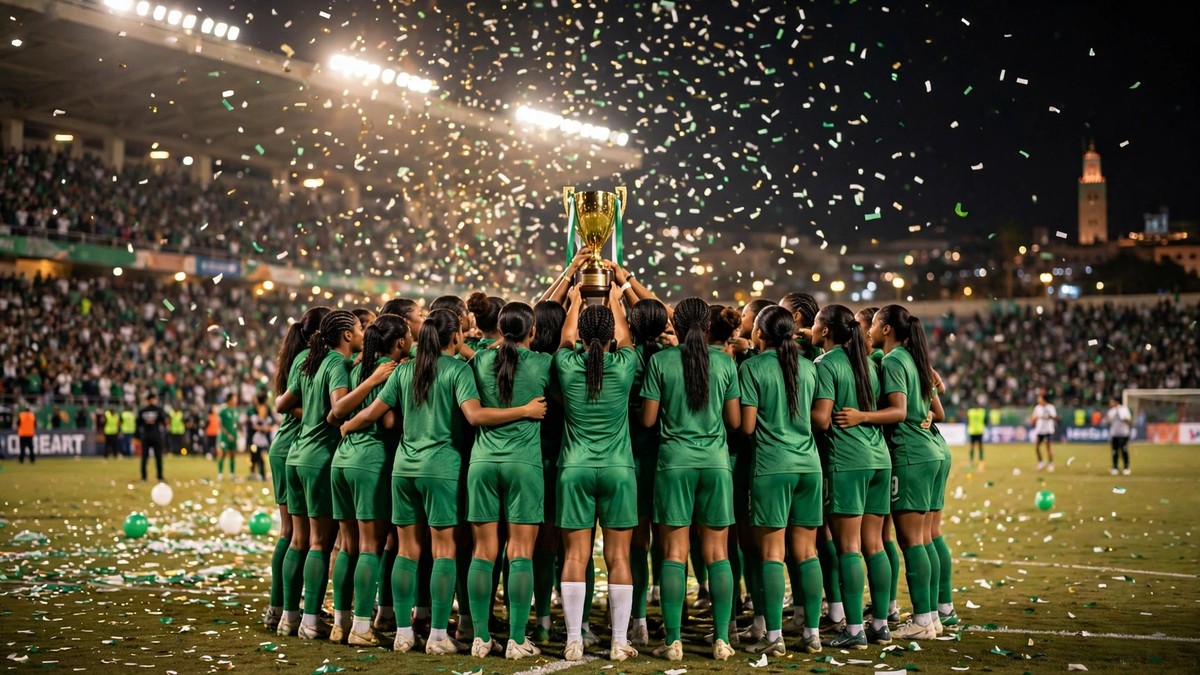
Six wins after one defeat, and a first for a whole continent. Nigeria’s teenagers are world champions.
KEY POINTS:
- Nigeria beat Japan 2-1 in the FIFA U-17 Women’s World Cup final in Rabat, Morocco, on Saturday 7 November 2026.
- Awawu Bashiru scored in the 39th minute and Oluebube Umejiaku in the 47th; Fuki Ito pulled one back for Japan in the 80th.
- Nigeria are the first African nation to win the tournament, and the first team ever to lose their opening match and still lift the trophy.
- Umejiaku, won the Golden Ball as the tournament’s best player, with three goals and two assists.
- Nigeria won six matches in a row after losing 2-1 to Poland in their opening group game.
Nigeria’s Flamingos beat Japan 2-1 in Rabat on Saturday to win the FIFA U-17 Women’s World Cup, the first world title for an African team in the tournament’s history.
What happened
Nigeria started the final at the Mohammed VI Football Complex on the front foot, and the opening goal arrived six minutes before half-time. Awawu Bashiru sent a dropping ball looping towards the Japan goal, and goalkeeper Kou Kadowaki, who had looked certain to catch it, saw it slip through her gloves and into the net.
The second came two minutes after the restart. Esther Stephen played a long pass upfield, Umejiaku raced on to it, took it down with her left foot and lifted a delicate lob over Kadowaki. At 2-0, Nigeria were in command.
Japan refused to fold. Their captain, Fuki Ito, a 16-year-old midfielder who plays for JFA Academy Fukushima, scored in the 80th minute. The goal set up a tense finish, and Nigeria held on.
The win capped an extraordinary campaign. Nigeria’s only defeat came in the opening match; they won six straight afterwards, and they conceded only two goals in the tournament, both to Poland and Japan. Captain Precious Oscar said it had been a privilege to lead the team and thanked Nigerians everywhere for their support. Coach Bankole Olowookere said the players deserved the win and thanked the players’ parents and the football federation for their backing.
The celebrations will continue when the Flamingos arrive back in Nigeria. President Bola Tinubu said the players had written their names in gold and promised they would be celebrated.
Why it matters
No African team had ever won this tournament before Saturday. The competition began in 2008, and until now the trophy had stayed in Asia, Europe and the Americas. Nigeria’s win breaks that pattern at a stroke.
The Flamingos lost 2-1 to Poland in their opening group match on 17 October. From there they won six in a row: Puerto Rico 2-0 and defending champions Korea DPR 3-1 to escape the group, Mexico 2-1 in the round of 16, Venezuela 1-0 in the quarter-finals through an 89th-minute penalty from Azeezat Oduntan, Brazil 3-1 in the semi-final, and now Japan. No team in the tournament’s history had ever lost its first match and gone on to win it.
The result also completes a set for Nigeria. The country’s men’s under-17 team, the Golden Eaglets, have won their World Cup five times – in 1985, 1993, 2007, 2013 and 2015. Nigeria are now the first African country to hold under-17 world titles in both the men’s and women’s game.
The Flamingos’ previous best finish was third place, a bronze medal at the 2022 edition in India.
For Japan, the defeat ends a strong run of their own. The Little Nadeshiko won the title in 2014 and finished runners-up in 2010 and 2016; this was their fourth final. They reached Rabat’s showpiece by beating defending champions North Korea in the semi-final, and they pushed Nigeria all the way on Saturday.
The individual honours matched the team prize. Umejiaku, a 16-year-old forward who plays for Heartland Queens, won the Golden Ball as the tournament’s best player. She scored three goals and made two assists across Nigeria’s seven matches, and her strike in the final proved the winner. She started the tournament on the bench and finished it as its standout player.
What happens next
Nigeria will go for back-to-back titles when the tournament returns in Morocco in 2027. For now, though, the Flamingos can enjoy the moment. Their win is a reminder that the best stories in sport are the ones that last, and that the next generation of African footballers is already here.
The final capped a remarkable week for world sport, in which Cristiano Ronaldo retired from international football and Mohammed Shami stepped away from Test cricket: two greats bowing out as Nigeria’s teenagers announced themselves.
Sources: FIFA, “Japan 1-2 Nigeria | Report and highlights | FIFA U-17 Women’s World Cup 2026 final”, 7 November 2026; Punch Newspapers, “Flamingos beat Japan 2-1 to win U-17 women’s World Cup”, 7 November 2026; Premium Times, “Flamingos make history, beat Japan to win Nigeria’s first U-17 Women’s World Cup title”, 7 November 2026; Channels Television, “Flamingos Beat Japan To Win Historic First U-17 Women’s World Cup Title”, 7 November 2026; Vanguard, “U17WWC: You’ve written your names in gold — Tinubu tells Flamingos”, 8 November 2026; Punch, “Flamingos’ Umejiaku named U-17 World Cup best player”, 7 November 2026. No Reuters, AP or BBC coverage of the final was found at the time of writing. Published: 8 November 2026, Kuala Lumpur time.