
India has unveiled three homegrown AI models designed to work in its own languages — and, for the smaller two, without an internet connection at all.
Key Points
- The IndiaAI Mission released three indigenous foundation models in New Delhi on Tuesday 3 November 2026: EKA-1, Dhīr 2B and Dhīr 5B.
- Soket Labs built EKA-1; ZenteiQ built Dhīr 2B and Dhīr 5B. Both firms were selected under the mission’s Foundation Models pillar.
- EKA-1 has 26.3 billion parameters, was trained on about 7.5 trillion tokens, and covers all 22 scheduled Indian languages plus English.
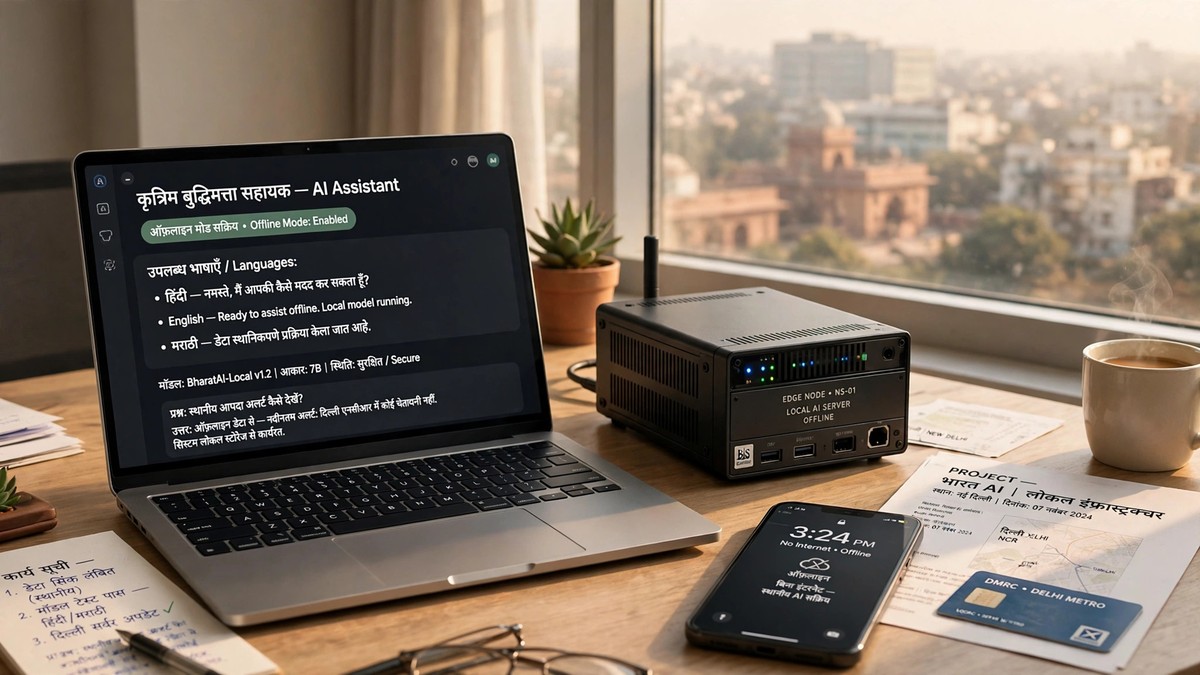
- Dhīr 2B and Dhīr 5B are open-source, support English and 10 Indian languages, and are built to run offline or on-premises.
- The models are aimed at maths, coding, research, banking, cybersecurity and document work in low-connectivity or sensitive settings.
- No independent benchmark results were published with the launch; performance claims remain the developers’ and the government’s own.
India’s government-backed IndiaAI Mission unveiled three homegrown AI models in New Delhi on Tuesday, built for Indian languages and offline use.
Why it matters, in brief: most leading AI systems are built abroad, trained mainly in English, and need a constant cloud connection. These three models are pitched as the opposite — Indian-built, multilingual from the start, and usable where the internet is weak or where data must stay inside a building. That makes them less about topping a global leaderboard and more about whether public offices, banks and hospitals in India can run AI on their own terms.
What happened
The three models were unveiled at an event in New Delhi attended by S Krishnan, secretary of the Ministry of Electronics and Information Technology (MeitY), along with senior ministry officials and leaders of both companies. The IndiaAI Mission, which runs under MeitY, presented the release as another step in building homegrown AI capability.
The larger model is EKA-1, from Soket Labs Technology and Research. It is a foundation model — a general-purpose system other tools can be built on — with 26.3 billion parameters and about 7.5 trillion tokens of training text. It covers all 22 scheduled Indian languages alongside English, and is aimed at mathematics, coding and reasoning, as well as banking, financial services and cybersecurity.
The two smaller models come from ZenteiQ AiTech Innovations. Dhīr 2B and Dhīr 5B are open-source multilingual assistants, meaning their code and weights can be inspected and reused under an open licence. They support English and 10 Indian languages and are designed for secure, on-premises use: document-grounded automation, knowledge retrieval and citizen or enterprise services that keep working without a live internet link.
MeitY secretary S Krishnan said the models suit specialised uses such as mathematics, coding, scientific research and cybersecurity, according to reporting of the launch event. The reporting seen did not include benchmark scores, deployment figures or pricing, so how the models compare with established international systems cannot yet be checked independently.
Why it matters
Language is the first reason this launch matters. India has 22 scheduled languages, and most everyday AI still works best in English. A model that handles those languages from the start could change who can actually use AI tools, rather than forcing every user through English first.
The second reason is control over data. The Dhīr models are built to run offline or inside an organisation’s own systems. For defence and government users, sensitive documents never have to leave the building to be summarised or searched. For places with patchy connectivity, the tool still works when the network does not.
The third reason is timing. This autumn has brought open and open-weight releases from Asian labs, including Tencent’s Hy4 and Moonshot AI’s Kimi K3.1 Pro. India’s launch follows that direction with a different emphasis: smaller, practical models for local languages and local deployment. It also adds to earlier IndiaAI Mission models from Sarvam AI, BharatGen and Gnani AI.
None of that proves quality on its own. Parameter counts describe size, not accuracy in any language. Until independent researchers test the released models, the honest reading is that India has shipped three tools with a clear purpose — and the proof of how well they work is still to come.
What happens next
Three things to watch. First, access: how easily researchers, students and firms can download and run the models. Second, independent testing in Indian languages on real government and enterprise documents. Third, adoption: whether banks, hospitals, schools or state offices pick the models up for live work, or whether they stay a demonstration rather than a daily tool.
Sources: TelecomLive, “IndiaAI Mission releases indigenous foundation models EKA-1, Dhīr 2B, Dhīr 5B”, 5 November 2026; The Hindu BusinessLine, IndiaAI Mission reports, 4 November 2026. No benchmark results were published with the launch; performance claims are the developers’ and the government’s own and await independent testing. Published: 5 November 2026, Kuala Lumpur time.