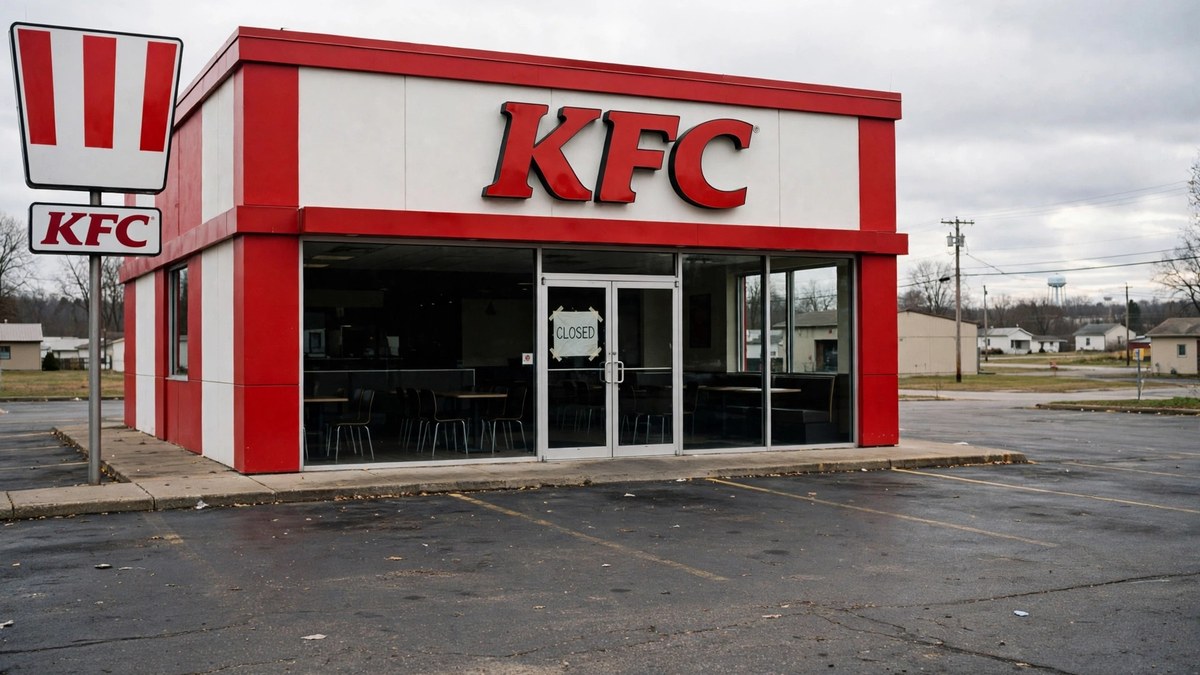
A KFC franchisee that runs 84 restaurants across 10 American states has filed for bankruptcy, after three years of falling sales and rising costs left it owing millions in unpaid fees.
The collapse is not about the fried-chicken chain itself. It is about what happens to the small operators who run its restaurants when customers stop coming, bills keep climbing, and the parent company demands expensive refits at the same time. Tasty Chick’n, the franchisee at the centre of it, now owes tens of millions of dollars, faces lawsuits from its landlords, and has put more than 70 of its restaurants on a list of sites it no longer sees as worth keeping.
Key Points
- Tasty Chick’n LLC filed for Chapter 11 bankruptcy on Monday, 16 November, in the US Bankruptcy Court for the Southern District of Texas.
- The company runs 75 KFC restaurants and nine combined KFC/Taco Bell sites — 84 in all — across 10 states, employing more than 1,600 people.
- Court papers filed on 17 November list more than 70 of those restaurants as closing soon, already shut, or winding down.
- Sales fell 15.6% over three fiscal years while restaurant-level profit margins dropped from about 11% in 2023 to 4% this year, the filing says.
- KFC itself has not filed for bankruptcy. Parent company Yum! Brands says the brand remains strong and is looking for new operators.
What happened
Tasty Chick’n, based in Plano, Texas, turned to the bankruptcy court after a slow squeeze became impossible to manage. Its own filing says sales slid by 15.6% over three years as food, labour and rent costs climbed, and the money each restaurant kept after its bills fell from about 11 cents in every dollar in 2023 to about 4 cents this year.
The debts piled up behind that slide. The company says it has nearly $73 million in funded debt and owes close to $16 million in unpaid royalties and other fees to KFC and Taco Bell’s franchising arms. It began putting off royalty payments in the middle of 2025 and stopped paying them altogether that November. The franchisors sent a default notice in December 2025 and, in September 2026, warned they intended to end the franchise agreements. Fourteen lawsuits from landlords in five states over unpaid rent and other charges are also hanging over the company.
The court papers filed on 17 November name the restaurants first in line to go. Nine leases are being handed back, including three in Memphis, Tennessee, three in Kentucky, two in Arkansas and one in Roanoke, Virginia. Dozens more had already shut their doors before the filing. Memphis has the most sites on the list, with 15, followed by Knoxville with six.
Tasty Chick’n is part of a bigger group, Tasty Restaurant Group, which also runs more than 150 Pizza Hut restaurants and more than 50 Burger Kings. The bankruptcy covers only the KFC and KFC/Taco Bell business, and the filing says the aim is to keep restaurants trading while a buyer is found through a court-supervised sale.
Why the KFC bankruptcy matters
The first thing to be clear about is what this is not. KFC is not going out of business, and most of its restaurants in the United States are run by other operators who are not part of this case. A KFC spokesperson told Nation’s Restaurant News the company remains confident in the strength of its brand. Anyone outside the 10 affected states — Alabama, Arkansas, Florida, Illinois, Indiana, Kentucky, Mississippi, Missouri, Tennessee and Virginia — will see no change at all.
What the case does show is how hard the economics of running a fast-food restaurant have become. The same squeeze is visible across the industry: big employers are under pressure on several fronts at once, and Microsoft has just offered voluntary buyouts to about 60,000 staff as it reshapes jobs around AI. For restaurant operators, the maths is unforgiving — thin margins, rising costs, and, in Tasty Chick’n’s case, franchise agreements that require nearly half of its sites to undergo substantial and expensive upgrades by 2029.
The wider picture for KFC in America is already one of shrinkage. Its US system sales fell 6% in the third quarter, and industry data cited by the New York Post counted 312 KFC restaurants closing permanently across the country in the year to July 2026, about 7.6% of the chain’s footprint. Tasty Chick’n is the latest and largest piece of that retreat, and its 1,600-plus workers are the ones who will feel it first.
Investors, meanwhile, are pouring record sums into AI: Anthropic raised $81.3 billion in the largest IPO on record this week. The contrast is stark — money flooding into one corner of the economy while a household-name restaurant operator in another corner cannot pay its rent.
What happens next
The bankruptcy court will now oversee a sale of the business, with a timetable running into January. The outcome of that process will decide how many of the 84 restaurants find a new owner and stay open, and how many close for good. Staff at the affected sites face weeks of uncertainty while the sale runs its course.
For customers, the practical advice is simple: check the KFC store locator or app before setting out, because several locations have already closed without any announcement, and more are expected to follow in the coming weeks. The list of closures is still moving, and the final count of shut restaurants will only be clear once the sale is done.
Sources: Knoxville News Sentinel, NorthJersey.com, TheStreet, Newsweek, Restaurant Dive, Nation’s Restaurant News. Published: 20 November 2026, Kuala Lumpur time.