Key Points
- Donald Trump said the United States and the Philippines had concluded a “very big trade deal” at a state luncheon in Manila on Wednesday.
- He gave no terms, no tariff rate and no timetable, and no document was signed.
- The Philippine president’s office described the outcome only as an understanding on economic cooperation.
- The Philippines’ ambassador to Washington confirmed nothing was signed.
- The 12.5% tariff on Philippine exports stays in place while negotiators keep talking.
The Trump Philippines trade deal announcement came at a state luncheon in Manila on Wednesday, but Manila released no terms, announced no agreement, and its ambassador confirmed nothing was signed.
What happened
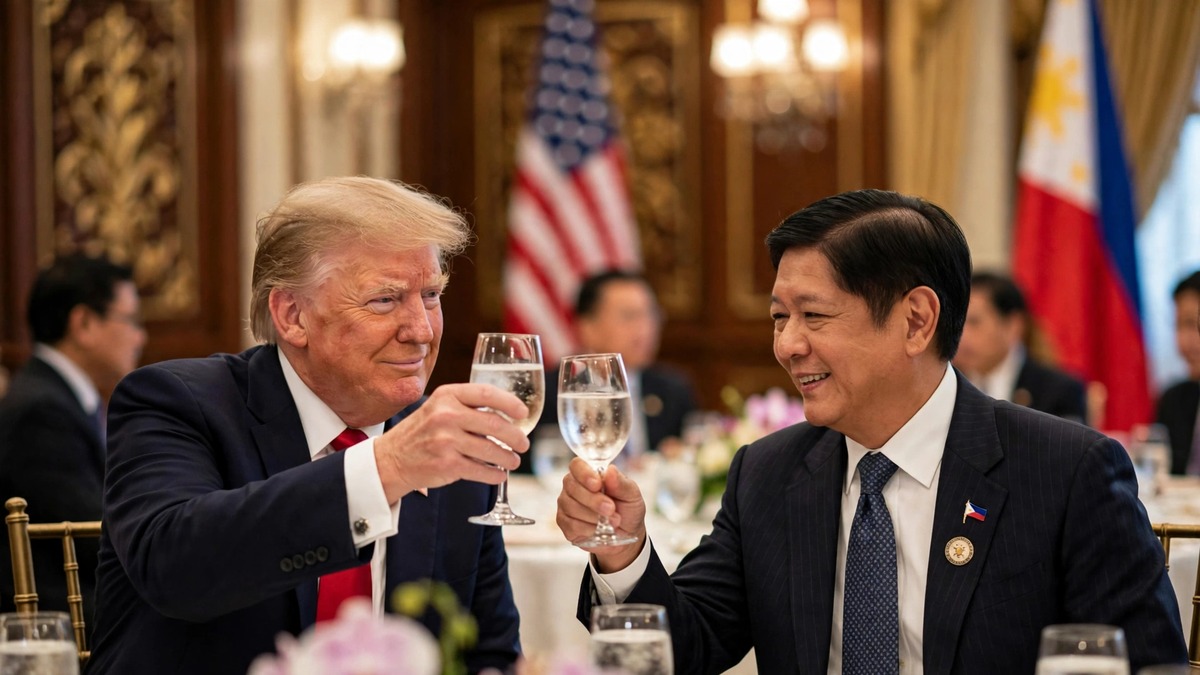
Donald Trump made the announcement at a state luncheon hosted by Philippine President Ferdinand Marcos Jr. at Malacanang Palace, the last event of his brief visit to Manila before he flew on to China.
“We’ve just consummated a very big trade deal, the biggest trade deal we’ve ever made so far, and it is a fair deal for both countries,” Trump said at the luncheon.
He added that the deal had not been expected. “We were very happy with that, and we didn’t know that was going to take place, but it took place very quickly and it’s a magnificent deal for both.”
No terms followed. Trump gave no tariff rate, no list of goods covered, no value and no timetable. Neither government published a text. Trade negotiations had not appeared in any schedule released by either side before the meeting, and the announcement itself had not been on the agenda of the talks.
The claim came a day after Trump said Thailand would scrap all tariffs and substantial non-tariff barriers on its imports from the United States, in a trade deal expected to be finalised in the coming weeks. He and Thai Prime Minister Anutin Charnvirakul signed a joint trade statement on Tuesday declaring that the two countries had substantially concluded negotiations on an agreement.
Trump’s visit to Manila was the first stop of a three-day Asia trip. He met the leaders of India, Japan and Australia in the Quad group on Tuesday, then held bilateral talks with Marcos on Wednesday before flying to Shenzhen, where he is due to meet Chinese President Xi Jinping and Russian President Vladimir Putin on Thursday.
Why the Trump Philippines trade deal claim matters
A trade deal normally leaves a paper trail. There is a written text, agreed tariff rates, rules on which goods qualify, and a signing. None of that exists for the Philippines announcement.
That gap matters because the tariff is real and still in force. Philippine exports have faced an additional 12.5% tariff from the United States since July, imposed after Washington said it found the Philippines had not adopted and effectively enforced a ban on imports made with forced labour. The tariff was one of the main items Manila wanted to raise in Wednesday’s talks, and Trade Secretary Cristina Roque had confirmed before the meeting that Manila would raise it and disclose the outcome afterward.
The gap also matters for the trip itself. Trump arrived in Asia after a bruising midterm election at home, and the visit was meant to show strength abroad. A headline trade deal that the other side will not confirm does the opposite. It hands his critics a simple question: where is the deal?
There is a second reason the wording counts. Trump did not only announce the deal at the luncheon. On the flight to China he posted on social media that “we made a new and completely different Trade Deal with the Philippines, one that will be a true landmark and, in particular, a Deal that will be great for our Farmers and those in the business of ‘Energy.'” The post repeated the claim in stronger language while Manila was still saying the opposite.
What the other side says
The Philippine president’s office answered hours later, and its words were careful. Both sides had reached an understanding on areas of economic cooperation, it said, but it made no mention of a trade deal. Trade representatives of both countries will work closely to translate the commitments into concrete initiatives, the statement added.
Marcos himself said nothing about a trade deal in his luncheon speech. He spoke instead of a partnership building stronger ties in trade, investment, energy, technology, resilient supply chains and education.
The clearest answer came from the Philippines’ ambassador to the United States, Jose Manuel Romualdez. He said the United States had offered to help the Philippines diversify its food supply and energy requirements. Asked whether anything was signed, he replied in a text message: “None.”
Finance Secretary Frederick Go gave the same picture in different words. “The US has offered to supply the Philippines with both energy resources and food products,” he said in a text message. “Our priority is to bring down the cost of these two essential commodities for every Filipino.” He added that Philippine trade negotiators will now take their discussions forward with the United States Trade Representative’s office.
Ralph Recto, executive secretary to Marcos, said on Wednesday that the tariff rate would still be negotiated. The White House did not immediately respond to a request for further information.
One agreement that had been expected did not happen at all. Marcos confirmed on Wednesday that the Pax Silica initiative, the United States-led effort to secure supply chains for semiconductors, artificial intelligence and critical minerals, would not be signed during Trump’s visit. “There is no signing. Not on this trip,” Marcos told reporters before the bilateral meeting. The United States ambassador to the Philippines, Lee Lipton, confirmed the same, and the country’s Board of Investments expects the signing to take place before the end of 2026.
Trump also used the Manila stop to talk up the wider relationship. “America stands with the Filipino people, as we have in generations,” he said at the start of his meeting with Marcos. “We’ve been your ally, but not as close as it is now.” He highlighted the Luzon Economic Corridor, an initiative of the two countries and Japan, saying the goal was to draw 100 billion dollars of investment into critical industries and bolster economic security in the Philippines.
What happens next
The talks now move to the negotiators. Philippine officials say their trade team will carry the discussion forward with the United States Trade Representative’s office, with the 12.5% tariff still to be settled. Until a text appears, businesses on both sides cannot tell whether the announcement changes anything they pay or sell.
Trump’s next test comes in Shenzhen on Thursday, when he meets Xi and Putin in their first trilateral meeting. That meeting is expected to cover nuclear arms control, the war in Ukraine and the conflict involving Iran.
For now, the record is simple. One president announced the biggest trade deal ever made. The other side said nothing was signed. Until Manila confirms a deal, publishes terms or puts pen to paper, the announcement stands as a claim, not an agreement.
Sources: Reuters; Moneycontrol; Philstar; Rappler; The Jerusalem Post; Free Malaysia Today; Sun Star. Published: Wednesday, November 18, 2026, 18:30 +08 (Asia/Kuala_Lumpur). All facts verified against the original report and at least one other outlet; direct quotes are exact.