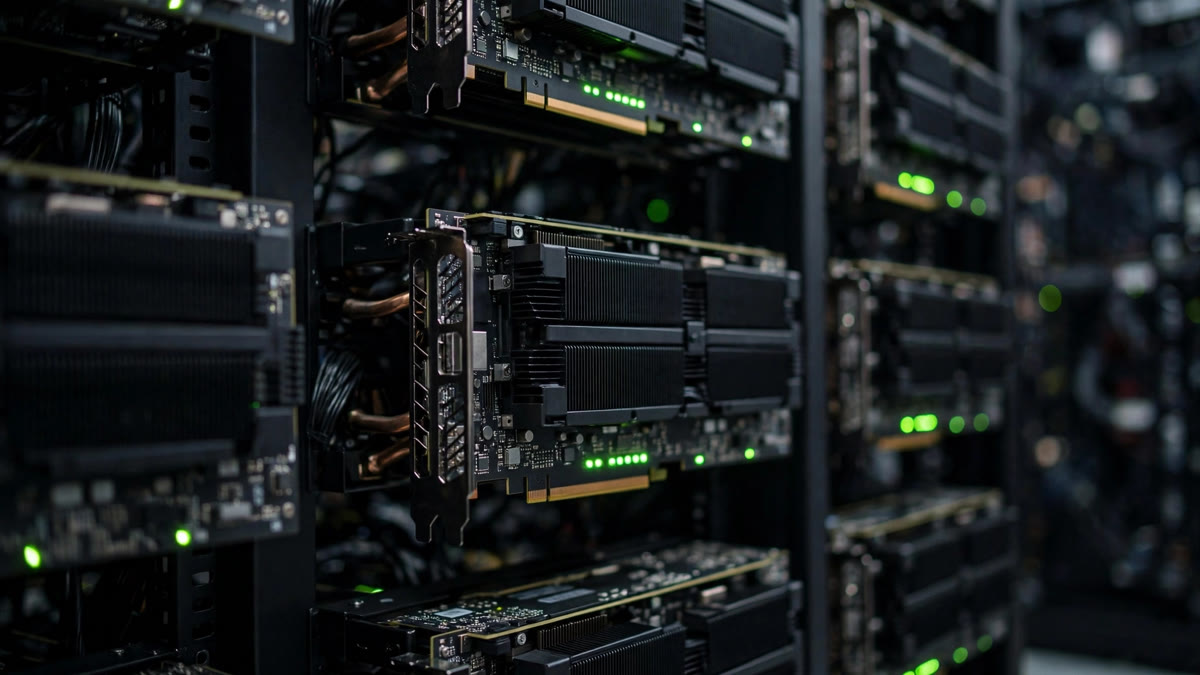
Six of China’s newest artificial intelligence models carry the hidden fingerprint of Nvidia’s Blackwell chips, which Washington bars from export to China, a forensic study published this week found.
The finding is the first technical evidence that four of China’s leading AI labs had access to hardware the United States says they should not have. It does not show where the chips sat, who supplied them, or whether any law was broken, and that gap is now the centre of the argument.
Key Points
- Former OpenAI researcher Will DePue, now at the nonprofit Unemployment Labs, published the analysis on 12 November.
- Six models released since April 2026 match Blackwell hardware patterns: DeepSeek-V4-Flash and V4-Pro, Moonshot’s Kimi K3 and Kimi K3.1 Pro, MiniMax-M3 and Ant Group’s Ling-3.1-flash.
- Two of the six match B200 and B300 chips. The other four match the larger Grace Blackwell GB200 and GB300 systems.
- The method was tested against 24 models whose hardware is publicly known. It named the right chip family every time.
- The study puts the hardware behind the runs at about 12,000 Blackwell chips, at a cost above $500 million. DePue himself says he is not confident in those figures.
- The evidence shows which hardware set each model’s starting values. It does not prove where the chips were, or that export rules were broken.
What happened
Every AI model starts as a table of numbers called weights. Before training begins, those numbers are filled in at random, using a starting value known as a seed. The software that does the filling splits the work across the chip’s processing units, and different chips split it differently. That split leaves a pattern behind. Some of the starting numbers survive training untouched, so the pattern can still be read in the finished model.
DePue searched more than six trillion combinations of chip layout and seed number, looking for matches in the published weights of open models from Chinese labs. He found six. DeepSeek-V4-Flash and MiniMax-M3 fit the 148-unit layout of Blackwell B200 and B300 chips. DeepSeek-V4-Pro, Kimi K3, Kimi K3.1-Pro and Ling-3.1-flash fit the 152-unit layout of Grace Blackwell GB200 and GB300 systems. The older Hopper chips these labs used before have 132 units.
The checks went further than a statistical match. DeepSeek used the same seed, 953049583, for its older V3 model and for V4-Flash. Run through unmodified PyTorch, a Hopper H100 chip rebuilt V3’s surviving starting values exactly, but none of V4-Flash’s. A Blackwell B300 did the reverse. A rented GB200 rebuilt all 13 of Kimi K3’s surviving rows with Moonshot’s seed, and changing either seed by one broke the match. The report’s code is public, so other researchers can repeat the test.
The switch is recent. DeepSeek’s V3, released in December 2024, still reads as Hopper. The Blackwell matches start with DeepSeek-V4-Flash and V4-Pro in April 2026, then MiniMax-M3 in June, Kimi K3 in July and Ling-3.1-flash in October. Newer open models from Alibaba, Zhipu, Tencent, Xiaomi and StepFun still read as Hopper, and DePue found no fingerprint at all in DeepSeek’s latest model, V4.1-Flash.
DePue wrote on X that the work rests on the companies’ own published files. “Again, this evidence isn’t based on any insider information or leaking. It’s based on a forensic analysis of the model weights released by the companies themselves.” He also says senior researchers at OpenAI and Anthropic checked the result on their own and confirmed it. Neither company has commented, and neither has named the people involved.
Why it matters
Washington has spent years trying to keep its most advanced AI chips out of China. The Trump administration has allowed some exports of the H200, built on the older Hopper design, but it has never approved exports of Blackwell or its successor, Rubin. If the fingerprint reading is right, four leading Chinese labs built their newest flagship models on hardware they were not supposed to reach.
The scale in the report is large. DePue estimates Kimi K3 alone needed about 4,500 Blackwell chips over roughly 70 days, and DeepSeek-V4-Pro about 3,000. Across the five runs he examined, the total comes to about 12,000 chips. At roughly $70,000 a chip, the biggest cluster would cost $200 million to $300 million, and all five together more than $500 million. Those numbers rest on run lengths and efficiency figures no lab has disclosed, and DePue has said plainly that he is not sure of them.
The report lands in a week when Nvidia itself is in turmoil. Jensen Huang resigned as chief executive on 12 November, after reports that United States intelligence believed an executive linked to the Singapore server firm Megaspeed had been recruited to spy on him. Megaspeed is under investigation in the United States and Singapore over claims it moved banned Nvidia chips to China. Nvidia’s board had already been weighing Huang’s future before he stepped down. The report does not name Nvidia as a source of the chips, and it does not claim any law was broken.
Congress is already moving. At least four bills aim to tighten the rules further, including the AI Overwatch Act, the Chip Security Act and the Cloud Security Act. Senators Jim Banks and Elizabeth Warren cited Huang’s reported link to a suspected Chinese spy when they pressed for the AI Overwatch Act this week. The Trump administration said on Thursday it was not sure whether Alice Huang, the Megaspeed-linked executive, was a spy, an allegation Beijing denies and the FBI is investigating.
Other evidence points the same way, without settling the question. Weeks ago, the Israeli security firm Lava said it had found 32 Nvidia B300 chips through publicly exposed monitoring systems with internet addresses located in China. United States officials had already claimed that DeepSeek and Moonshot were using Blackwell chips, but they had never published technical proof. DeepSeek has said publicly that it wants to train its biggest model on Huawei chips.
The limits of the new study matter as much as its findings. A fingerprint shows which hardware produced a model’s starting values, not every chip used in training, and it says nothing about who owned the chips or where they were. Blackwell systems can be rented from data centres outside China, and current export rules largely do not cover remote access to chips abroad. An AMD MI300X chip, which is also restricted, can be set up to mimic the same layouts. DePue says he ruled that out for DeepSeek-V4-Flash and calls it very unlikely for the other five. Nvidia, DeepSeek, Moonshot AI, MiniMax, Ant Group and the United States Commerce Department have not commented on the report.
What happens next for the Blackwell findings
The code behind the analysis is public, so other researchers can now test the claim on the same model weights. If the matches hold up under that scrutiny, Congress and the Commerce Department will have technical evidence to work with, even though it still will not show where the chips were or how the labs reached them.
The open question is the route. Rental abroad, smuggling, or a mix of both would each point to a different fix, and the bills now before Congress take different paths: some would lock the export rules into law, others would reach into cloud access overseas. Until the labs answer, or investigators trace a shipment, the fingerprint proves access to the hardware, and nothing more.
Sources: Unemployment Labs, The Register, The Decoder, SBS, ChosunBiz, madrobot. Published: 15 November 2026.